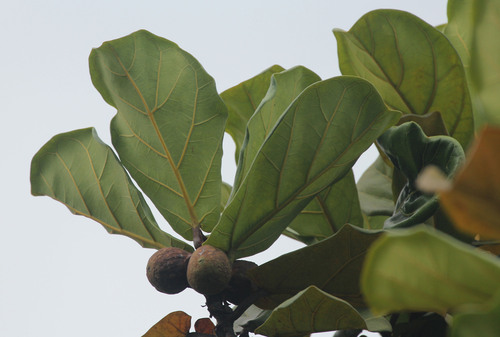
Fiddle-leaf Fig
Ficus lyrata
With its massive, violin-shaped leaves and commanding presence, the Fiddle-leaf Fig is the ultimate 'it' plant of the modern landscape. Discover how this tropical giant breathes life into our spaces and how you can track its subtle, slow-motion movements.
Quick Identification
Size
Grows 40–50 feet (12–15 m) tall in the wild; typically 6–10 feet (1.8–3 m) as a domestic specimen.
Colors
Deep waxy green leaves with pale yellow-green or reddish-brown veins; trunk features greyish-brown bark.
Key Features
- Large, violin or lyre-shaped leaves up to 18 inches long
- Prominent, recessed veins creating a quilted texture
- Stiff, upright woody stems
- Waxy, leathery leaf surface with a slight sheen
When You’ll See Them
Behavior
The Fiddle-leaf Fig is a slow-growing perennial known for its dramatic, architectural foliage. In its native West African rainforest habitat, it often starts its life as an epiphyte, germinating in the high canopy of a host tree and eventually sending 'strangler' roots down to the soil. In suburban gardens or indoor settings, it is a vertical grower that prioritizes leaf surface area to capture filtered light.
While stationary to the naked eye, the Fiddle-leaf Fig is highly responsive to its environment. It exhibits phototropism, where the leaves will slowly angle themselves toward the strongest light source. It is also known for being temperamental; it reacts to environmental stress—like sudden drafts or changes in humidity—by dropping its lower leaves as a survival mechanism to conserve energy and moisture.
EverydayEarth exclusive
Camera Tips
Capturing the life of a Fiddle-leaf Fig requires a shift from traditional motion-triggering to time-lapse photography. To document its growth and health, mount your camera on a stable tripod or wall mount at mid-height of the plant, roughly 3 to 5 feet off the ground. Angle the lens slightly downward to capture the top of the canopy where new growth (the 'flushing' of new leaves) occurs. This is the most exciting stage to record, as new leaves emerge from a brownish sheath and expand rapidly over several days.
Set your camera to take a photo every 2 to 4 hours during daylight hours. AI-powered cameras are particularly useful here for health monitoring; by comparing daily images, the AI can detect early signs of leaf droop or 'edema' (small red spots caused by moisture stress) long before they become visible to a casual observer. This allows you to adjust your watering schedule or lighting before the plant suffers permanent damage.
Lighting is the biggest challenge when filming this species. Because Fiddle-leaf Figs are often placed near windows, the shifting glare can wash out your images. Use a polarizing filter if your camera supports it, or position the camera so the window is to the side rather than directly behind or in front of the plant. If you are monitoring an outdoor specimen, the best footage is captured in the early morning or late afternoon when the 'golden hour' light highlights the deep texture and venation of the leaves.
Similar Species
Species that look similar or are commonly confused with Fiddle-leaf Fig.
Frequently Asked Questions
Record Fiddle-leaf Fig at your habitat
Connect a camera to start building your own species record — AI identifies every visitor automatically.