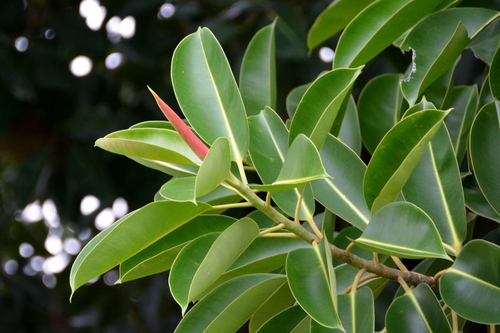
rubber plant
Ficus elastica
A titan of the tropical forest that has found its way into backyards across the globe, the Rubber Plant is famous for its massive, glossy foliage and dramatic aerial roots.
Quick Identification
Size
30-40 meters (100-130 feet) tall in the wild; canopy spread up to 30 meters (100 feet). Trunk diameter can reach 2 meters (6.6 feet).
Colors
Deep glossy green leaves; new growth is encased in a bright red or pink sheath; some cultivars feature burgundy or cream-and-pink variegation.
Key Features
- Thick, leathery oval leaves 10-35 cm long
- Milky white latex sap visible when stems are broken
- Bright red protective sheath (stipule) on new leaf buds
- Massive aerial and buttress roots in mature outdoor specimens
When You’ll See Them
Behavior
The Rubber Plant is a vigorous and resilient evergreen tree known for its unique growth habits. In its native tropical environment, it often begins life as an epiphyte, growing in the crevices of other trees before sending down long aerial roots that eventually anchor into the soil and 'strangle' or support the host. In a backyard setting, it is characterized by its rapid vertical growth and its ability to thrive in both full sun and deep shade, making it a highly adaptable species.
While it appears static, the Rubber Plant is highly reactive to its environment. It produces a thick, milky latex sap that serves as a chemical defense against herbivores; this sap is toxic to many animals and irritating to human skin. The plant also exhibits a fascinating symbiotic relationship with specialized fig wasps for pollination, though this rarely occurs outside its native range. In urban and suburban landscapes, its behavior is often defined by its aggressive root system, which actively seeks out moisture and can lift pavement or invade pipes if not properly managed.
EverydayEarth exclusive
Camera Tips
To capture the most compelling footage of a Rubber Plant, you should pivot your AI-powered camera from motion-triggering to time-lapse mode. The most dramatic biological event is the emergence of a new leaf. Position your camera a few inches away from a red-sheathed bud and set a capture interval of one frame every 30 to 60 minutes. Over several days, you will document the 'uncloaking' process where the red sheath builds pressure and eventually bursts, falling to the ground to reveal a perfectly furled lime-green leaf that slowly expands and hardens.
Lighting is your biggest challenge due to the plant's extremely waxy, reflective cuticle. Midday sun often creates 'blown-out' white spots on the leaves that can ruin a photo. For the best results, set your camera to record during the 'golden hours' of early morning or late afternoon. The low-angle light will highlight the architectural veins of the leaves and the translucent quality of the red leaf sheaths without the harsh glare. If your camera is placed in a backyard, try to position it so the sun is behind the plant, which creates a beautiful rim-light effect around the thick leaf margins.
While the plant itself doesn't move, it is a hub for backyard wildlife. To capture animal interactions, aim your camera at the trunk or the junction of large branches. In many regions, the dense canopy of the Rubber Plant is a preferred nesting site for birds like cardinals or mourning doves, and the thick, smooth bark is a popular highway for lizards and arboreal insects. Use a high-resolution setting (4K if available) to capture the fine details of the aerial roots, which have a fascinating, rope-like texture that looks incredible in close-up macro shots.
Similar Species
Species that look similar or are commonly confused with rubber plant.
Fiddle Leaf Fig
Features much larger, violin-shaped leaves with prominent veins and a matte texture compared to the oval, waxy leaves of the rubber plant.
Southern Magnolia
Often confused due to glossy leaves, but magnolias have brown fuzzy undersides and produce large, fragrant white flowers rather than hidden figs.
Weeping Fig
A close relative with much smaller, thinner leaves and a drooping branch habit, whereas the rubber plant is upright and stiff.
Frequently Asked Questions
Record rubber plant at your habitat
Connect a camera to start building your own species record — AI identifies every visitor automatically.