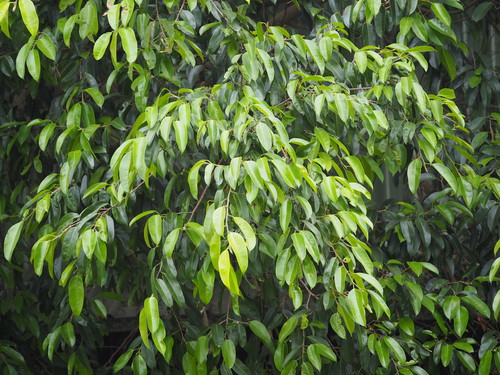
Weeping fig
Ficus benjamina
With its graceful, arching branches and glossy emerald leaves, the Weeping Fig is more than just a popular houseplant—it's a vibrant sanctuary for backyard birds and a centerpiece of tropical landscapes.
Quick Identification
Size
60-100 ft (18-30 m) tall in the wild; 3-10 ft (1-3 m) when grown in containers or small gardens.
Colors
Glossy deep green foliage; some variegated varieties have white or yellow edges. Bark is a smooth, light silvery-gray.
Key Features
- Graceful drooping branches with a 'weeping' habit
- Glossy, ovate leaves with a distinct pointed tip
- Smooth, light gray bark that can develop aerial roots
- Small, pea-sized fruit that turns from green to red or black
When You’ll See Them
Behavior
The Weeping Fig is a master of adaptation, known for its elegant, arching branches that create a dense, umbrella-like canopy. In its native tropical habitats, it can grow into a massive giant, sometimes even beginning life as an epiphyte before sending roots down to the ground. In a backyard setting, it is often more contained, providing excellent shade and privacy screening. However, it is a sensitive soul; it is famous for its 'stress response' of dropping leaves whenever it is moved or experiences a sudden change in light or temperature.
Beyond its visual appeal, the Weeping Fig is a bustling hub for local ecology. It provides critical nesting sites for small birds and a feast of small figs for fruit-eating species. In urban environments, it acts as a natural air filter and a 'biomonitor,' helping to scrub pollutants from the air. While it appears passive, its root system is incredibly vigorous and 'determined,' often seeking out moisture far beyond the drip line of its canopy.
EverydayEarth exclusive
Camera Tips
Capturing the beauty of a Weeping Fig with a trail camera is less about the tree's movement and more about the life it hosts. To see the tree 'breathe,' set your camera to time-lapse mode. A photo taken every hour during daylight can show the subtle lifting and drooping of the leaves in response to the sun, or even the rapid growth of new light-green buds during the spring flush. Position the camera on a nearby structure or a different tree to get a wide-angle view of the entire canopy.
If your goal is to capture the wildlife that visits the tree, focus your camera on the mid-canopy where the small figs are most abundant. These fruits are a magnet for birds like cedar waxwings, parrots (in Florida), and various songbirds. Use a high-speed trigger setting to catch birds mid-flight as they land on the thin, swaying branches. Because the foliage is dense, you may need to clear a few small twigs directly in front of the lens to prevent the infrared sensor from being triggered by wind-blown leaves.
Lighting is your best friend when photographing this species. Position your camera so that the morning or late afternoon sun is 'backlighting' the leaves. This makes the glossy foliage glow and highlights the intricate branch structure. If you are using an AI-powered camera like those from EverydayEarth, ensure the camera is angled slightly downward from an elevated position to capture the activity of ground-foraging birds that hunt for fallen figs around the base of the trunk.
Similar Species
Species that look similar or are commonly confused with Weeping fig.
Frequently Asked Questions
Record Weeping fig at your habitat
Connect a camera to start building your own species record — AI identifies every visitor automatically.