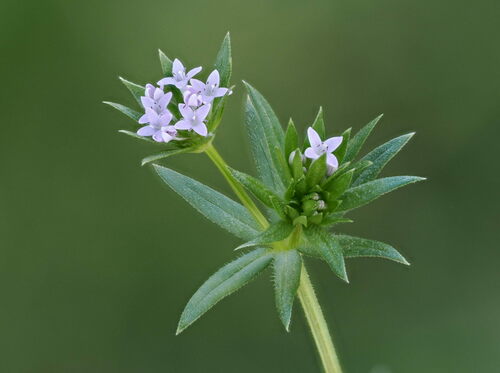
Field madder
Sherardia arvensis
A delicate, star-flowered gem often hidden in plain sight, field madder brings a splash of lilac to garden borders and wild lawns.
Quick Identification
Size
A low-growing, prostrate plant with stems typically 5-40 cm (2-16 inches) long.
Colors
Tiny pale lilac, lavender, or light blue flowers; bright green foliage.
Key Features
- Leaves arranged in whorls of 4-6 along the stem
- Tiny four-petaled flowers in terminal clusters
- Square stems covered in small, downward-pointing bristles
- Involucre of 6-8 leaf-like bracts surrounding the flower head
When You’ll See Them
Behavior
Field madder is a resilient annual or biennial herb that belongs to the coffee family (Rubiaceae). It exhibits a creeping or decumbent growth habit, often forming low mats across the ground. Unlike its more aggressive relatives, field madder is relatively petite and often goes unnoticed in lawns and pastures until its tiny, star-shaped flowers bloom in the late spring. It relies on its rough, bristly stems and leaves to scramble over other low-growing vegetation and deter small crawling herbivores.
As a pioneer species, field madder excels at colonizing disturbed soils, garden borders, and cracks in pavement. While humans often classify it as a minor weed, it plays a subtle role in the backyard ecosystem by providing a nectar source for small pollinators such as hoverflies and tiny solitary bees. It is a hardy plant, capable of surviving in various soil types as long as it has access to moderate sunlight.
EverydayEarth exclusive
Camera Tips
Capturing field madder with an AI-powered backyard camera requires a focus on macro-level details since the plant is low-profile. To get the best shots of its tiny lilac blooms, place your camera on a ground-level mount or a very low tripod. Aim the lens at a 45-degree angle downward to capture both the whorled leaf structure and the terminal flower clusters. If your camera has a 'close-up' or macro mode, ensure it is enabled, as the individual flowers are often less than 3mm wide.
Lighting is crucial for this species; the pale lavender petals can easily look washed out in harsh midday sun. Aim for the 'golden hours'—shortly after sunrise or before sunset—when the soft, directional light highlights the bristly texture of the square stems and the delicate veins in the leaves. If your camera supports time-lapse features, setting it to take a frame every 15 minutes during a sunny morning can reveal the subtle way the plant adjusts its foliage toward the light.
Because field madder is a magnet for small insects, your camera may trigger frequently if set to high sensitivity for motion. Use this to your advantage to document the 'micro-wildlife' visiting your yard. Look for small hoverflies or beetles that frequent the flowers. To avoid false triggers from wind-blown grass nearby, try to clear a small perimeter of taller vegetation around the field madder patch so the AI can focus specifically on the plant and its visitors.
Similar Species
Species that look similar or are commonly confused with Field madder.
Frequently Asked Questions
Record Field madder at your habitat
Connect a camera to start building your own species record — AI identifies every visitor automatically.