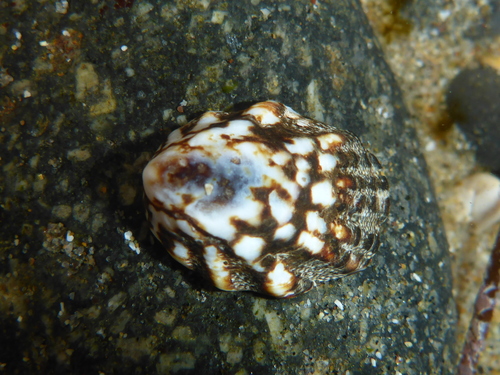
Fingered Limpet
Lottia digitalis
The Fingered Limpet is a rugged survivor of the Pacific surf, known for its distinctive ribbed shell and its incredible ability to 'home' back to the same spot on a rock after every meal.
Quick Identification
Size
Typically 1.5–3.5 cm (0.6–1.4 inches) in length; height is usually about half the length.
Colors
Dull greyish-green or olive-brown with irregular white spots or mottling; interior is bluish-white with a dark brown owl-shaped stain at the center.
Key Features
- Strongly radiating ribs that give the edge a 'fingered' or scalloped look
- Apex (point) of the shell is hooked and located very close to the front edge
- Often found in clusters on vertical rock faces
- Shell is roughly oval and higher than many other common limpets
When You’ll See Them
Geographic range
Where Does the Fingered Limpet Live?
The Fingered Limpet is a native inhabitant of the North American Pacific coast, stretching from the cold waters of the Aleutian Islands in Alaska all the way south to the tip of Baja California, Mexico. It is most densely populated along the rugged coastlines of British Columbia, Washington, Oregon, and Northern California. These hardy snails are strictly coastal, thriving in the 'splash zone' where they are regularly dampened by waves but remain above water for significant portions of the day.
Basemap © OpenStreetMap contributors
Behavior
The Fingered Limpet is a master of survival in the harsh high-intertidal zone, where it must endure both the pounding surf and the drying sun. Unlike more mobile creatures, these limpets exhibit 'homing' behavior. When the tide is high or the rocks are splashed with spray, they move slowly across the rock surface to graze, but as the tide recedes, they often return to the exact same 'home scar'—a slight depression in the rock that perfectly fits their shell shape to create an airtight seal and prevent dehydration.
These mollusks are surprisingly social in their spacing, often clustering together in crevices or on the shaded sides of rocks to share moisture. They are highly sensitive to the movement of the tide and the presence of predators like sea stars and oystercatchers. If a predator is detected, the limpet can pull its shell down with incredible force, suctioning itself to the rock so tightly that it is nearly impossible to remove without tools.
EverydayEarth exclusive
Camera Tips
Capturing the secret life of a Fingered Limpet requires a shift in perspective, as these subjects move in 'snail time.' To see them in action, set your camera to time-lapse mode. A photo taken every 30 to 60 seconds over a four-hour window—spanning the transition from low tide to high tide—will reveal their grazing treks and their remarkable ability to return to the same spot on the rock.
Because these limpets live in the splash zone, a waterproof action camera is essential. Use a heavy-duty suction cup mount or a weighted 'bean bag' tripod to secure the camera to a flat rock surface. Positioning the camera at a low angle, nearly parallel to the rock, will provide a dramatic 'limpet’s-eye view' of the ribs and the shell's unique profile against the horizon.
Lighting can be tricky on the coast. Overcast days are actually better for photography as they reduce the harsh glare off wet shells and rocks. If you are filming at night, use a camera with a built-in ring light or a diffused external light source to avoid 'hot spots' on the reflective surfaces of the intertidal zone. Be sure to check tide tables carefully and never place equipment where it could be swept away by an incoming 'sneaker wave.'
Similar Species
Species that look similar or are commonly confused with Fingered Limpet.
Frequently Asked Questions
Record Fingered Limpet at your habitat
Connect a camera to start building your own species record — AI identifies every visitor automatically.