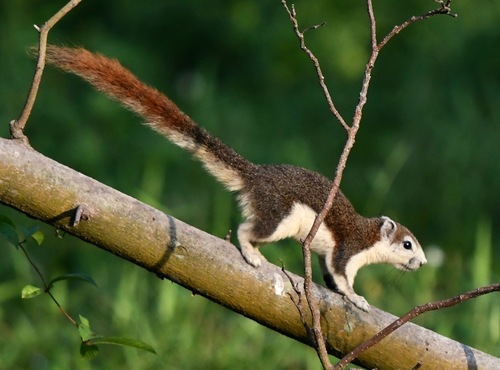
Finlayson's Squirrel
Callosciurus finlaysonii
Widely known as the Variable Squirrel, this Southeast Asian native is a master of disguise, appearing in colors ranging from snowy white to midnight black. A bold and charismatic climber, it is as comfortable in a remote jungle as it is in a bustling city park.
Quick Identification
Size
Head-body length 19–22 cm (7.5–8.7 in); tail length 17–24 cm (6.7–9.4 in); weight 250–375 g (8.8–13.2 oz).
Colors
Incredibly diverse; colors range from pure white or jet black to deep red, mahogany, or tri-colored patterns depending on the subspecies. Markings are uniform within a local population but vary wildly across the range.
Key Features
- Extreme color variation between populations
- Long, bushy tail roughly equal to body length
- Agile, slender build with sharp climbing claws
- Rounded ears and large, dark eyes
When You’ll See Them
Geographic range
Where Does the Finlayson's Squirrel Live?
Finlayson's Squirrel is native to the Indochinese peninsula in mainland Southeast Asia. Its core range encompasses the diverse wooded landscapes of Thailand, Cambodia, Laos, Vietnam, and Myanmar. Beyond its native shores, this adaptable squirrel has established thriving introduced populations in Italy, Japan, and Singapore, often stemming from the pet trade.
Basemap © OpenStreetMap contributors
Behavior
Finlayson's Squirrel, often called the Variable Squirrel, is a highly active and arboreal rodent known for its incredible agility. Unlike some ground-dwelling squirrels, this species spends the vast majority of its time in the canopy, leaping between branches with remarkable precision. They are strictly diurnal, meaning they are active during the day, with peak activity occurring shortly after sunrise and again in the late afternoon before dusk.
In urban environments like Bangkok or Ho Chi Minh City, these squirrels have become remarkably bold and habituated to human presence. They are frequently seen traversing power lines or raiding garden bird feeders. While generally solitary when foraging, they are not overly territorial and can often be seen in high densities where food is abundant, communicating with a series of sharp chirps and tail flicks when sensing a predator or a rival.
EverydayEarth exclusive
Camera Tips
Because Finlayson's Squirrels are primarily arboreal, the biggest mistake people make is placing their camera too low. For the best results, mount your camera at least 5 to 8 feet up a tree trunk. Angle the camera slightly downward toward a sturdy, horizontal branch or a platform where you can place attractants. Using a strap-on tree mount or a flexible tripod will allow you to get the lens right where the action is.
To lure these colorful acrobats into view, use high-energy treats. Slices of banana, papaya, or even a smear of peanut butter on a branch work wonders. In suburban settings, a standard bird feeder filled with sunflower seeds will almost certainly attract them, but be prepared for them to dominate the scene! If you want to capture their natural climbing behavior, place the bait in a way that forces them to stretch or hang, which makes for dynamic, professional-looking footage.
Set your camera to a fast shutter speed or high-frame-rate video mode. These squirrels move in quick, jerky bursts, and a slow shutter will result in a blurry tail and nothing else. Since they are most active in the early morning, ensure your camera has a wide aperture or decent low-light sensors to capture those first golden hours of activity without excessive grain. In tropical regions, check your lens for fogging during the humid morning hours; a small rain hood or shield can help keep the glass clear for that perfect shot.
Similar Species
Species that look similar or are commonly confused with Finlayson's Squirrel.
Frequently Asked Questions
Record Finlayson's Squirrel at your habitat
Connect a camera to start building your own species record — AI identifies every visitor automatically.