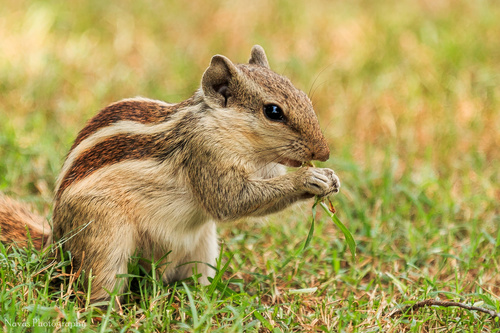
Five-striped Palm Squirrel
Funambulus pennantii
Meet the Five-striped Palm Squirrel, the high-speed acrobat of the South Asian garden. With its bold racing stripes and bird-like chirps, this adaptable rodent is a favorite for backyard observers and wildlife photographers alike.
Quick Identification
Size
Head and body length of 13–15 cm (5–6 in) with a tail of equal length; weight ranges from 90–120 g (3.2–4.2 oz)
Colors
Grizzled grey-brown upperparts with five distinct creamy-white longitudinal stripes; belly is off-white or creamy
Key Features
- Five prominent light-colored stripes on the back
- Bushy tail often held in an upright S-shape
- High-pitched, bird-like 'chip-chip' vocalization
- Small, rounded ears and large, dark expressive eyes
When You’ll See Them
Geographic range
Where Does the Five-striped Palm Squirrel Live?
The Five-striped Palm Squirrel is primarily native to the Indian subcontinent and surrounding regions of Southern Asia. Its core population thrives across most of India, Pakistan, Nepal, and Bangladesh, extending westward into parts of Iran. Due to its adaptability, it has also been introduced to several other parts of the world, establishing wild populations in Australia, Israel, and even parts of the Caribbean.
Basemap © OpenStreetMap contributors
Behavior
The Five-striped Palm Squirrel is a bundle of nervous energy, characterized by its quick, jerky movements and constant alertness. They are semi-arboreal, which means they are just as comfortable scurrying across a stone wall or garden floor as they are leaping through the canopy of a Banyan tree. They are highly social and often live in loose colonies, sharing communal nests located in tree hollows or constructed from grass and twigs in the forks of branches.
These squirrels are famous for their vocalizations. When a predator like a domestic cat or a bird of prey is spotted, they emit a rhythmic, metallic chirping sound while flicking their tails in time with each note. In urban areas, they have become remarkably habituated to humans, often venturing onto verandas to steal food or investigate household objects, though they remain flighty and will dash for cover at any sudden movement.
EverydayEarth exclusive
Camera Tips
To capture the best footage of the Five-striped Palm Squirrel, placement is key. These rodents are 'pathway' animals, meaning they follow the same routes every day. Mount your camera 3 to 4 feet off the ground on a tree trunk, or along the top of a garden wall or fence line. Because they are incredibly fast, you will need a camera with a trigger speed of 0.3 seconds or faster. Use a multi-shot or burst mode (3-5 photos per trigger) to ensure you catch them in a clear pose rather than just a blur of fur.
Baiting is an effective way to get them to pause for the camera. A small platform feeder or even a flat rock stocked with unsalted peanuts, sunflower seeds, or chunks of fruit like banana or papaya will keep them in the frame. If you want to capture more natural behavior, place the camera near a water source; in hot climates, these squirrels are frequent visitors to birdbaths or dripping taps to stay hydrated. Position the camera about 5-8 feet away from the bait to ensure the wide-angle lens captures their entire body and bushy tail.
Since they are strictly diurnal, you don't need to worry about infrared settings, but you should be mindful of shadows. The best lighting occurs during the 'golden hours'—shortly after sunrise and before sunset—which conveniently coincides with their peak activity periods. If your camera allows for video, set it to 15-20 second clips. This will allow you to capture their unique tail-flicking communication and high-speed grooming sessions, which are much more engaging than static photos.
Similar Species
Species that look similar or are commonly confused with Five-striped Palm Squirrel.
Frequently Asked Questions
Record Five-striped Palm Squirrel at your habitat
Connect a camera to start building your own species record — AI identifies every visitor automatically.