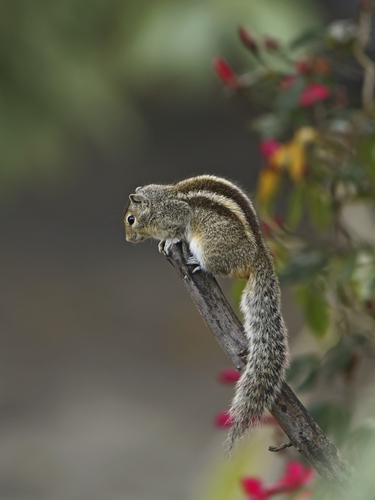
Three-striped Palm Squirrel
Funambulus palmarum
South Asia's most famous garden acrobat, the Three-striped Palm Squirrel, is as vocal as it is vibrant. Known for its bold personality and striking racing stripes, this agile climber is a favorite for backyard observers and trail cam enthusiasts alike.
Quick Identification
Size
Head-body length of 15–20 cm (6–8 in) and a tail of roughly 15 cm (6 in); weighs between 100–120g (3.5–4.2 oz).
Colors
Grizzled grey-brown upperparts with three prominent creamy-white longitudinal stripes; underparts are off-white to pale grey.
Key Features
- Three distinct light stripes running from neck to tail
- Bushy, plume-like tail with mixed black and white hairs
- Small, rounded ears and large dark eyes
- Active, bird-like chirping vocalizations
When You’ll See Them
Geographic range
Where Does the Three-striped Palm Squirrel Live?
The Three-striped Palm Squirrel is native to the southern regions of the Indian subcontinent, specifically across central and southern India and the island of Sri Lanka. Beyond its native Asian range, the species was successfully introduced by humans in the late 19th century to several Western Indian Ocean territories. Today, thriving populations can be found across Madagascar, Réunion, Mayotte, the Comoro Islands, Mauritius, and the Seychelles.
Basemap © OpenStreetMap contributors
Behavior
The Three-striped Palm Squirrel is a highly energetic and vocal rodent that has adapted seamlessly to human presence. Unlike many of its forest-dwelling relatives, this species is remarkably bold, often seen scurrying along garden walls, rooftops, and telephone wires. They are strictly diurnal, beginning their day at sunrise with a series of high-pitched, metallic chirps that can easily be mistaken for bird calls. These vocalizations serve as both social communication and alarm signals to warn the colony of nearby predators like cats or hawks.
While they are agile climbers that spend much of their time in the canopy of palm and fruit trees, they are also frequent ground-foragers. They are semi-social and are often observed in pairs or small family units, particularly during the breeding season. In urban environments, they exhibit a high degree of intelligence and memory, often returning to the same garden spots where they have previously found food or water.
EverydayEarth exclusive
Camera Tips
To capture the best footage of Three-striped Palm Squirrels, position your camera along 'arboreal highways'—the tops of fences, flat garden walls, or low-hanging horizontal branches. These squirrels are creatures of habit and will use the same routes daily to move between nesting sites and feeding grounds. Aim the camera at a height of 3 to 5 feet, and if you are using a fence as a backdrop, ensure the lens is angled to capture their lateral profile to highlight their iconic stripes.
Baiting is an excellent way to keep these fast-moving mammals in the frame long enough for a clear shot. A small platform feeder or a flat stone stocked with sunflower seeds, peanuts, or sliced fruit like bananas and grapes works wonders. Because they are incredibly fast, set your camera to 'Burst Mode' or 'Photo + Video.' A trigger speed of 0.2 seconds or faster is ideal; otherwise, you might only capture a blurry tail as they zip past the sensor.
Lighting is your best friend for making the three dorsal stripes pop. Try to place your camera in an area that receives bright, indirect morning light. Since they are most active shortly after sunrise and again in the late afternoon before dusk, make sure your PIR sensor sensitivity is set to 'High' to detect their small heat signatures during these cooler periods. In the summer months, placing a shallow water dish in front of the camera is often more effective than food for attracting them during the heat of the day.
Similar Species
Species that look similar or are commonly confused with Three-striped Palm Squirrel.
Frequently Asked Questions
Record Three-striped Palm Squirrel at your habitat
Connect a camera to start building your own species record — AI identifies every visitor automatically.