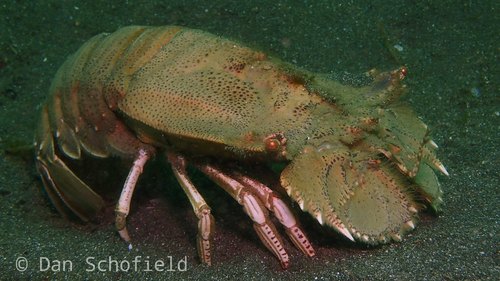
Flathead Lobster
Thenus orientalis
A bizarre and beautiful marvel of the Indo-Pacific, the Flathead Lobster uses its shovel-shaped face to vanish into the sand. This master of camouflage is one of the ocean's most unique bottom-dwellers.
Quick Identification
Size
Length up to 25 cm (10 inches); average weight 150-400g (0.3-0.9 lbs)
Colors
Pale sandy tan or olive-brown carapace with fine reddish-brown spotting; creamy white underside; dark brown or purple markings on the leg joints
Key Features
- Broad, shovel-like flattened antennae
- Wide, flat carapace with no large pincers
- Small eyes set wide apart at the carapace corners
- Strong, muscular tail used for rapid backward swimming
When You’ll See Them
Geographic range
Where Does the Flathead Lobster Live?
The Flathead Lobster is native to the warm tropical and subtropical waters of the Indo-West Pacific. Its core range extends from the eastern coast of Africa and the Red Sea across to the Persian Gulf, moving eastward through the waters of India, Southeast Asia, and China. It is particularly prevalent in the coastal northern half of Australia, especially within the protected waters of Moreton Bay, and stretches across the Indonesian archipelago and the Philippines.
Basemap © OpenStreetMap contributors
Behavior
The Flathead Lobster, commonly known in some regions as the Moreton Bay Bug, is a master of camouflage and benthic living. Unlike many of its clawed relatives, this slipper lobster has evolved a remarkably flat profile that allows it to disappear into the sandy or muddy substrates of the ocean floor. It is a strictly nocturnal creature, spending its daylight hours almost entirely buried in the sediment with only its small, periscope-like eyes and sensitive antennae protruding to monitor for predators or passing prey.
While they appear slow-moving as they crawl along the seabed, Flathead Lobsters possess a powerful 'tail-flip' escape mechanism. When threatened, they rapidly contract their abdominal muscles to propel themselves backward through the water, creating a cloud of silt that further confuses their pursuers. They are generally solitary but can be found in high densities where food is abundant or substrate conditions are ideal for burrowing.
EverydayEarth exclusive
Camera Tips
Capturing high-quality footage of a Flathead Lobster requires an underwater camera setup, making it an exciting challenge for those living near coastal waters or piers. For the best results, use a waterproof trail camera or a specialized 'drop cam' mounted on a weighted base to prevent it from drifting with the current. Since these lobsters are strictly nocturnal and sensitive to bright light, it is essential to use infrared (IR) or red-light LEDs. Standard white flashes will often cause the lobster to immediately perform an escape flip, leaving you with nothing but a cloud of sand.
Placement is key to success. Look for 'backyard' marine environments like sandy patches near rock groynes or soft-bottomed areas under coastal docks. Position the camera at a low angle, roughly 10-20 cm (4-8 inches) off the seabed, tilted slightly downward. This perspective captures the lobster's unique 'walking' motion and its shovel-shaped head as it emerges from the substrate. If you notice small 'v' shaped disturbances in the sand during the day, you have likely found a burrowing site where they will emerge after sunset.
To guarantee an appearance in front of the lens, use a scent-based lure. A perforated PVC pipe filled with crushed mussels, fish scraps, or oily sardines works exceptionally well. Secure the lure approximately 30 cm (12 inches) directly in front of the camera. The scent will draw the Flathead Lobster out of hiding, often resulting in footage of the animal using its shovel-like antennae to investigate the source. For settings, use a short video mode (15-20 seconds) with high motion sensitivity, as their movements can be subtle until they start feeding.
Similar Species
Species that look similar or are commonly confused with Flathead Lobster.
Balmain Bug
The Balmain Bug has eyes set closer to the midline of its head, while the Flathead Lobster's eyes are at the extreme outer edges.
Mediterranean Slipper Lobster
Much larger and more robust with a bumpy, rocky-textured carapace compared to the smoother, flatter profile of the Flathead Lobster.
Frequently Asked Questions
Record Flathead Lobster at your habitat
Connect a camera to start building your own species record — AI identifies every visitor automatically.