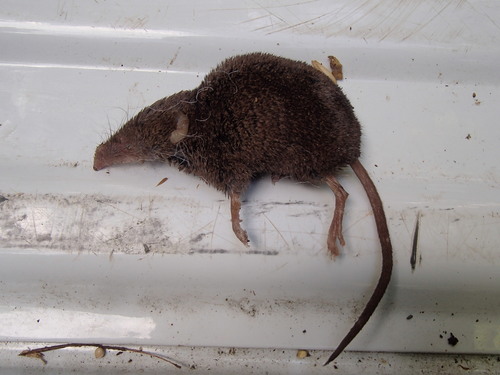
Fog Shrew
Sorex sonomae
Master of the mossy underworld, the Fog Shrew is a tiny powerhouse of the Pacific Northwest. Endemic to the damp coastal forests, this elusive hunter spends its life in a perpetual race to feed its high-speed metabolism.
Quick Identification
Size
Total length 140–180 mm (5.5–7.1 in); weight 10–18 g (0.35–0.63 oz)
Colors
Uniformly dark brown to sooty-gray upper parts with slightly paler, smoky-brown underparts; tail is bi-colored (darker on top).
Key Features
- Large for a shrew, with a notably long tail
- Elongated, pointed snout with highly sensitive whiskers
- Small, dark, bead-like eyes and ears mostly hidden by thick fur
- Five toes on each foot, visible in clear mud tracks
When You’ll See Them
Geographic range
Where Does the Fog Shrew Live?
The Fog Shrew is a North American endemic with a specialized distribution along the Pacific coast. It is found exclusively in the United States, where its core range stretches from the Olympic Peninsula in Washington southward through coastal Oregon and into Northern California, reaching as far south as the San Francisco Bay. Within this region, it is most common in the humid 'fog belt' where moisture levels remain high throughout the year, supporting the lush undergrowth they require.
Basemap © OpenStreetMap contributors
Behavior
The Fog Shrew is a high-octane tiny predator that lives life at an incredible pace. Due to an exceptionally high metabolic rate, these mammals are active throughout the day and night, alternating between intense foraging bursts and short periods of sleep. They are primarily solitary and highly territorial, using scent glands to mark their tunnels and ward off rivals. Unlike many other small mammals, they do not hibernate and must remain active year-round to satisfy their constant need for calories.
In the wild, they are the 'engine' of the forest floor, constantly turning over leaf litter and aerating the soil. While they are generally shy and rarely seen by humans due to their preference for dense cover, they are incredibly bold when hunting. They rely on their keen sense of touch and smell rather than sight to navigate their subterranean world and the complex 'runways' they create under the ferns and mosses of the Pacific Northwest.
EverydayEarth exclusive
Camera Tips
Capturing a Fog Shrew on camera requires a 'macro' mindset. These animals are small and stay close to the ground, so your camera must be mounted very low—no more than 2 to 4 inches off the forest floor. Instead of mounting to a large tree trunk, consider using a small stake or a ground-mount system. Angle the lens slightly downward to focus on a patch of ground about 3 to 5 feet in front of the sensor. High-quality PIR sensors are a must, as their small body mass may not always trigger older or less sensitive trail cameras.
Because Fog Shrews are incredibly fast, photos often result in a 'motion blur' or a tail disappearing from the frame. Set your camera to Video Mode with a short duration (10–15 seconds) and the highest possible frame rate. This will allow you to see their characteristic twitchy movements and long snouts in action. If your camera has a 'close focus' setting or lens attachment, this is the perfect time to use it, as the best shots are often captured at a very short range.
To encourage a Fog Shrew to linger in front of your lens, use a scent-based lure or a small amount of bait. Dried mealworms or a tiny smear of canned cat food (rich in protein) placed near a rotting log or a known 'runway' in the moss can be highly effective. Place the bait in a spot that is clear of tall grass or moving leaves to prevent false triggers and ensure a clear line of sight. Foggy or drizzly nights are actually the best times to see them active, so don't let bad weather stop you from deploying your gear.
Similar Species
Species that look similar or are commonly confused with Fog Shrew.
Frequently Asked Questions
Record Fog Shrew at your habitat
Connect a camera to start building your own species record — AI identifies every visitor automatically.