Forbes' Glory-of-the-snow
Scilla forbesii
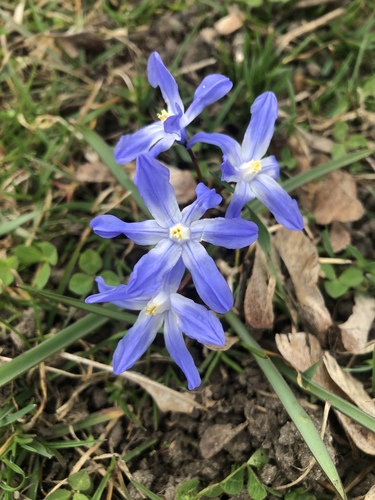
A brilliant sapphire carpet that defies the winter chill, Forbes' Glory-of-the-snow is one of the first splashes of color in the spring garden. These star-shaped blooms face skyward, offering a vital early feast for the season's first pollinators.
Quick Identification
Size
Height: 4-6 inches (10-15 cm); Flower diameter: 1 inch (2.5 cm)
Colors
Brilliant gentian-blue petals with a distinct, large white center (eye) and pale stamens
Key Features
- Upward-facing, star-shaped blue flowers
- Prominent white central 'eye'
- 4-12 flowers per brownish-green stem
- Narrow, strap-like green leaves
When You’ll See Them
Behavior
Forbes' Glory-of-the-snow is a spring ephemeral, meaning it completes its above-ground life cycle in a few short weeks while the soil is moist and the deciduous trees overhead are still leafless. It is one of the earliest plants to emerge, often pushing its way through lingering snow crusts. Unlike many of its relatives in the Scilla family that have nodding, bell-like flowers, this species is known for its 'upward-looking' habit, with blooms that face the sky to catch the maximum amount of early spring sunlight.
These plants are highly efficient colonizers. Once established in a backyard or woodland edge, they spread through both bulb offsets and a prolific self-seeding process. Because they go dormant by early summer, they effectively 'vanish' from the garden, allowing other plants to take their place while the bulbs rest underground. They provide a vital early-season nectar source for the first emerging queen bumblebees and honeybees.
EverydayEarth exclusive
Camera Tips
Capturing the beauty of Forbes' Glory-of-the-snow requires getting down to their level—literally. To get the best results with a backyard camera, you must mount your device at 'ground-beetle height.' Position your camera just 2 to 4 inches off the soil, perhaps using a low-profile beanbag mount or a small stake. Angle the lens slightly upward; this perspective makes the small 4-inch plants look like a towering forest of sapphire stars and ensures the camera captures the signature white 'eye' of the bloom.
Because these plants are stationary, they are the perfect subject for time-lapse photography. Set your camera to take one frame every 15 minutes during the first week of March. When played back, you will see the dramatic 'heave' of the earth as the green spears pierce the mulch, followed by the rapid unfurling of the blue petals. This species is highly responsive to light; you can document the flowers opening wide in the morning sun and closing into tight tubes as the temperature drops in the evening.
Lighting is your biggest challenge with blue flowers. Direct midday sun can wash out the delicate blue pigments and create harsh shadows in the white centers. For the most professional-looking 'hero' shots, target the 'golden hours'—either the two hours after sunrise or two hours before sunset. The softer, diffused light will make the gentian-blue appear deeper and more saturated. If your camera has a macro setting, use it to focus on a single cluster of three or four blooms to create a beautiful blurred background (bokeh) of the rest of the colony.
To capture 'action' shots, remember that these flowers are magnets for the season's first pollinators. Set your camera's motion trigger to its highest sensitivity and focus on a healthy, sun-drenched cluster. Early-season queen bees are heavy and move relatively slowly as they forage for nectar, providing excellent opportunities for the AI to trigger a high-speed burst. Ensure the area around the plant is clear of tall dead grass or debris that might blow in the wind and cause false triggers.
Similar Species
Species that look similar or are commonly confused with Forbes' Glory-of-the-snow.
Frequently Asked Questions
Record Forbes' Glory-of-the-snow at your habitat
Connect a camera to start building your own species record — AI identifies every visitor automatically.