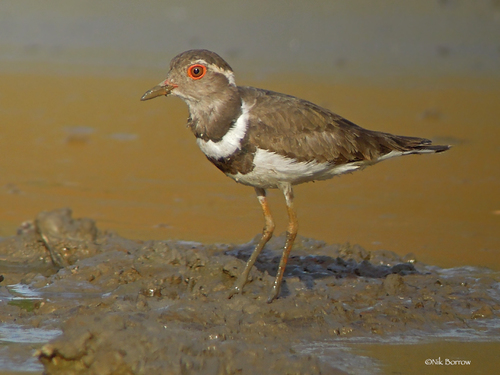
Forbes's Plover
Thinornis forbesi
A distinctive inland wader of West Africa, Forbes's Plover is easily recognized by its striking double breast bands and bold red eye-rings. This adaptable bird bridges the gap between wild rocky uplands and modern landscapes like golf courses and airfields.
Quick Identification
Size
Length of 19–21 cm (7.5–8.3 in); weight approximately 50–70g (1.8–2.5 oz)
Colors
Olive-brown upperparts, white underparts with two distinct black breast bands, a white forehead, and a vivid red eye-ring.
Key Features
- Two dark horizontal breast bands
- Prominent red orbital ring around the eye
- White forehead and supercilium
- Long wings extending past the tail
- Slender black bill with a red base
When You’ll See Them
Geographic range
Where Does the Forbes's Plover Live?
Forbes's Plover is native to the African continent, primarily found across West and Central Africa. Its core range extends from Guinea and Sierra Leone eastward through the Guinea savanna belt to Nigeria and Cameroon, reaching as far south as Angola and parts of Zambia. While it is a resident across much of this tropical humid zone, it performs significant local migrations within these countries to follow the seasonal rains.
Basemap © OpenStreetMap contributors
Behavior
Forbes's Plover is a ground-dwelling specialist known for the classic "run-and-pause" foraging style typical of the plover family. Unlike many shorebirds that stick strictly to coastlines, this species is highly adapted to inland environments. During the breeding season, they are somewhat secretive, nesting in rocky upland areas where their mottled plumage provides excellent camouflage against stones and sparse vegetation.
When the dry season arrives, their behavior shifts as they migrate locally toward more open, human-altered landscapes. They are frequently observed on golf courses, airfields, and recently burnt grasslands. While they are generally solitary or found in pairs, they can be surprisingly tolerant of human presence in these suburban or industrial settings, provided they have a clear line of sight to spot potential predators.
EverydayEarth exclusive
Camera Tips
To capture Forbes's Plover on a trail camera, placement is everything. These birds spend nearly all their time on the ground, so mount your camera just 10 to 20 centimeters (4-8 inches) above the surface. Aim for a flat area with very short grass or bare earth, such as the edge of a gravel path or a clear patch in a field. Because they are relatively small, a wide-angle lens might make them look tiny; if your camera has a focal adjustment, set it for mid-range subjects.
In the dry season, water is the ultimate draw. A low-profile birdbath or even a shallow depression in the ground kept filled with water can act as a magnet for Forbes's Plover. They are more likely to visit these water sources during the heat of the afternoon. If you are placing a camera near a golf course or airfield edge, ensure the camera is well-camouflaged to avoid human interference, but keep the lens clear of swaying grass which can trigger false recordings.
Since these birds move with quick, sudden dashes, use a camera with a fast trigger speed (0.3 seconds or less) and set it to take photo bursts or short video clips. High-definition video is particularly useful for seeing the double breast bands and the red eye-ring, which are the primary ID markers. Early morning light provides the best color rendition for their subtle olive-brown plumage.
Similar Species
Species that look similar or are commonly confused with Forbes's Plover.
Frequently Asked Questions
Record Forbes's Plover at your habitat
Connect a camera to start building your own species record — AI identifies every visitor automatically.