Forest red gum
Eucalyptus tereticornis
The Forest Red Gum is a towering icon of the Australian east coast, prized by Koalas for its leaves and by birds for its nectar-rich white blossoms.
Quick Identification
Size
Height: 20–50 m (65–165 ft); Trunk diameter: up to 2 m (6.6 ft)
Colors
Smooth, mottled bark in patches of white, grey, and bluish-grey; dull green lance-shaped leaves
Key Features
- Smooth bark that sheds in irregular patches to create a mottled look
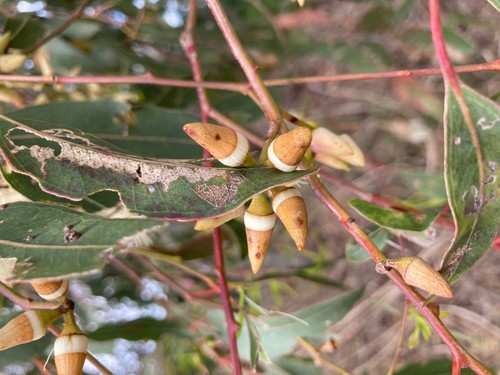
- Distinctive long, horn-shaped bud caps (opercula)
- Hemispherical woody fruit with 4-5 valves protruding upwards
- Narrow, curved green leaves that smell of eucalyptus when crushed
When You’ll See Them
Geographic range
Where Does the Forest red gum Live?
Native to the eastern coast of Australia and parts of southern New Guinea, the Forest Red Gum has a massive latitudinal range. It thrives from the tropical northern tip of Queensland down through the temperate regions of New South Wales into eastern Victoria. This wide distribution makes it one of the most recognizable trees in eastern Australia, where it is frequently found both in wild bushland and as a significant shade tree in suburban parks and larger backyards.
Basemap © OpenStreetMap contributors
Behavior
The Forest Red Gum is a keystone species of the Australian landscape, providing critical infrastructure for a vast array of wildlife. Unlike many other trees that provide only shelter, this eucalypt is a primary food producer. It undergoes a seasonal bark-shedding process known as decortication, where the old, weathered bark falls away in large flakes to reveal a fresh, smooth surface underneath, which helps the tree stay healthy and shed epiphytes.
Ecologically, it is famous for being a 'primary browse' species for Koalas, who select it specifically for the nutrient profile of its leaves. During the flowering season, the tree produces a massive amount of nectar-rich white blossoms, turning the canopy into a high-traffic hub for honeyeaters, lorikeets, and flying foxes. In a backyard or park setting, it acts as a high-rise apartment complex, with older trees developing hollows that house everything from Microbats to Powerful Owls.
EverydayEarth exclusive
Camera Tips
To capture the wildlife that frequents a Forest Red Gum, you need to think vertically. Because these trees are often quite tall, mounting a camera on the trunk at eye level will mostly get you shots of climbing reptiles like Lace Monitors or the occasional Koala descending to change trees. For the best results, aim your camera at a 'junction'—the spot where a large lateral branch meets the main trunk. This is a common resting spot for owls and a transit point for possums.
If your goal is to photograph the spectacular birdlife, position your camera on a nearby structure or a shorter tree facing the Red Gum's outer canopy during the flowering months (winter and spring). Use a fast shutter speed to freeze the motion of nectar-feeding birds. If your camera has a time-lapse mode, setting it to take a photo every 15 minutes during the day can reveal the slow, deliberate movement of Koalas that might otherwise be missed by a standard motion sensor.
For nocturnal activity, the Forest Red Gum’s smooth bark is highly reflective. If you are using infrared flash, avoid pointing the camera directly at a flat white patch of bark, as it will likely 'white out' the image. Instead, angle the camera across the curve of a branch. This creates depth and prevents the flash from bouncing directly back into the lens, ensuring you get clear, detailed shots of Sugar Gliders or Ringtail Possums as they navigate the canopy.
Similar Species
Species that look similar or are commonly confused with Forest red gum.
Frequently Asked Questions
Record Forest red gum at your habitat
Connect a camera to start building your own species record — AI identifies every visitor automatically.