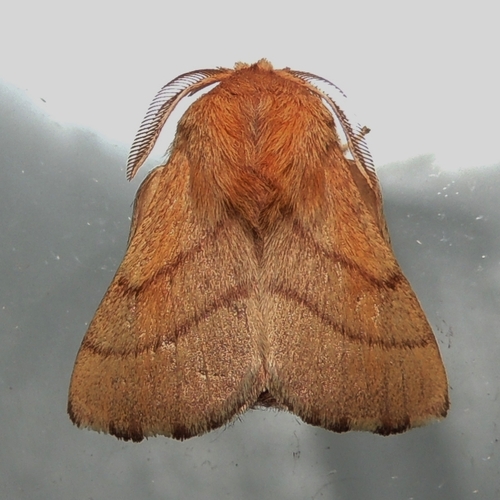
Forest Tent Caterpillar Moth
Malacosoma disstria
The Forest Tent Caterpillar Moth is a master of social silk-weaving and a common summer visitor to backyards across North America. While its larvae are famous for their blue-striped coats and footprint-shaped spots, the adult moths are elegantly furry, tan-colored flyers of the night.
Quick Identification
Size
Wingspan of 25–45 mm (1–1.75 inches); Larvae reach up to 50 mm (2 inches)
Colors
Moths are buff-brown to tan with two darker, thin diagonal bands on the forewings; caterpillars are dark brown or black with blue lateral stripes and white footprint-shaped spots on their backs.
Key Features
- Stout, furry buff-colored body
- Two dark diagonal lines on forewings
- Caterpillar has white 'keyhole' or 'footprint' spots
- Larvae do not build silk tents
- Feathery antennae on males
When You’ll See Them
Geographic range
Where Does the Forest Tent Caterpillar Moth Live?
Native to North America, the Forest Tent Caterpillar Moth is widely distributed across the continent, from the boreal forests of Canada down to the Gulf of Mexico. Its core range spans nearly every state in the eastern and central United States, though it is notably abundant in areas with heavy stands of deciduous trees like aspen and oak. Unlike some localized species, this moth is a common sight in both wild woodlands and urban parklands, making it a frequent visitor to suburban backyards throughout its vast territorial expanse.
Basemap © OpenStreetMap contributors
Behavior
Despite their name, Forest Tent Caterpillar Moths are unique because their larvae do not actually build the silk 'tents' associated with their close relatives. Instead, the caterpillars are highly social creatures that weave flat, silky mats on the trunks or branches of host trees where they gather in large masses to rest and molt. They communicate through pheromone-laden silk trails, traveling in groups to feeding sites at the tips of branches before returning to their communal resting spot.
As the caterpillars mature, they become more solitary, eventually spinning a yellow-tinted silk cocoon in a leaf or a sheltered crevice. The adult moths are strictly nocturnal and are famous for their attraction to artificial lights. They do not feed as adults, living only long enough to mate and for the females to deposit their egg masses in distinctive, foam-covered rings around the twigs of host trees.
EverydayEarth exclusive
Camera Tips
To capture the adult Forest Tent Caterpillar Moth, your best strategy is to set up your camera near a light source. Using an AI-powered camera with a macro lens focus is ideal, as these moths are relatively small. You can create a 'moth station' by hanging a white sheet with a UV or mercury vapor light directed at it; the moths will land on the sheet, providing a stable, high-contrast background for clear, detailed images of their furry bodies and wing patterns.
For the caterpillar stage, look for the 'mats' of silk on the trunks of host trees like oak, maple, or aspen during the late spring. Mount your camera on a tree strap or a nearby tripod at eye level, focusing on these silk patches. Since the caterpillars often mass together in the hundreds, time-lapse photography is an excellent way to capture their social movement and molting behaviors. Ensure your camera is set to a close-focus mode to capture the distinctive white 'footprint' spots on their backs.
Pay attention to the seasons for the best results. Adult moths are typically only active for a short window in mid-summer, while the caterpillars are most visible in late spring. If you find a ring-like egg mass on a twig in the winter, mark the spot; this is a guaranteed location for high activity once the spring thaw begins. Use a high shutter speed if capturing the moths in flight, but for resting moths or caterpillars, a lower shutter speed with natural light will yield the most professional-looking wildlife shots.
Similar Species
Species that look similar or are commonly confused with Forest Tent Caterpillar Moth.
Frequently Asked Questions
Record Forest Tent Caterpillar Moth at your habitat
Connect a camera to start building your own species record — AI identifies every visitor automatically.