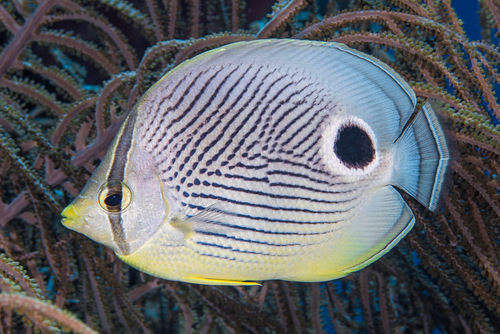
Four-eyed Butterflyfish
Chaetodon capistratus
A master of deception, the Four-eyed Butterflyfish uses a clever 'false eye' to outsmart predators on the Atlantic's most vibrant coral reefs.
Quick Identification
Size
3 to 6 inches (7.5 to 15 cm) in length; typically weighing under 0.5 lbs (0.2 kg)
Colors
Silvery-white body with thin dark lines in a chevron pattern; features a prominent black eye-spot ringed in white near the tail and a black vertical bar through the real eye.
Key Features
- Large false eye-spot near the tail base
- Thin black lines meeting in chevrons along the sides
- Black vertical bar masking the real eye
- Flattened, disk-shaped body with a small protruding snout
When You’ll See Them
Geographic range
Where Does the Four-eyed Butterflyfish Live?
The Four-eyed Butterflyfish is a vibrant native of the Western Atlantic Ocean, claiming a vast territory that stretches from the temperate waters of Massachusetts and Bermuda down through the sun-drenched West Indies and the Gulf of Mexico. Its core population thrives along the coastlines of the United States, Mexico, and the northern reaches of South America, particularly around the coral-rich waters of Brazil. While most abundant in tropical Caribbean reefs, this resilient species is a common sight across the western edge of the Atlantic basin, rarely venturing into the open ocean far from the shelter of the continental shelf.
Basemap © OpenStreetMap contributors
Behavior
The Four-eyed Butterflyfish is a diurnal species, meaning it is most active during the daylight hours when it can be seen flitting gracefully between coral heads. They are famous for their monogamous social structure, frequently traveling in pairs that may stay together for years. This pair-bonding is not just social; it provides better defense against egg predators during spawning and increases foraging efficiency across the reef.
Their most striking behavioral trait is their use of mimicry for survival. When threatened, the fish will point its head down and swim slowly, making the large 'four-eye' spot near its tail look like a massive head to potential predators. This confuses the attacker, who strikes at the wrong end, allowing the butterflyfish to escape in the opposite direction. They are generally peaceful but can be territorial towards other butterflyfish of the same species.
EverydayEarth exclusive
Camera Tips
To capture high-quality footage of the Four-eyed Butterflyfish, you will need a waterproof action camera or an AI-powered underwater housing positioned near shallow reef structures (3-10 feet deep). Because these fish are shy, avoid mounting the camera directly onto vibrant, living coral; instead, use a weighted tripod or a 'gorilla-pod' style mount secured to a dead coral skeleton or a rocky outcrop near a known feeding site.
Lighting is the biggest challenge underwater. For the best color reproduction of their silvery chevrons, aim for mid-morning or early afternoon when the sun is directly overhead to penetrate the water column. If you are using a triggered camera, set the white balance to 'Underwater' or 'Cloudy' to counteract the blue-green tint of the ocean. Position the lens slightly upward toward the surface to capture the natural light filtering through the water, which highlights the iridescent sheen of their scales.
While we don't recommend artificial baiting in delicate reef ecosystems, you can 'lure' them by placing your camera near their preferred food sources, such as sea fans or brain corals. These fish are creatures of habit and often patrol the same small patch of reef daily. If you spot a pair, they are likely to return to that exact spot within 15-20 minutes. Set your camera to a high frame rate (60fps or higher) to capture their quick, darting movements as they peck at coral polyps.
Similar Species
Species that look similar or are commonly confused with Four-eyed Butterflyfish.
Frequently Asked Questions
Record Four-eyed Butterflyfish at your habitat
Connect a camera to start building your own species record — AI identifies every visitor automatically.