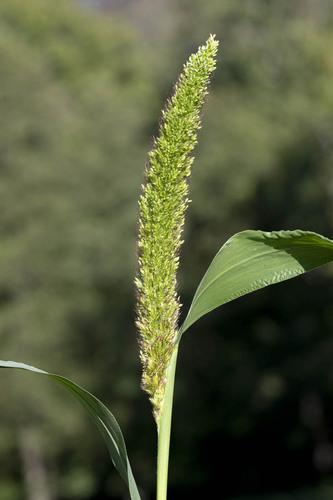
Foxtail Bristle-grass
Setaria italica
An ancient grain with a modern purpose, Foxtail Bristle-grass is a stunning ornamental that doubles as a high-energy buffet for backyard birds. Its fuzzy, arching seed heads bring both movement and a wealth of wildlife to your camera's field of view.
Quick Identification
Size
Stands 2 to 5 feet (60–150 cm) tall; seed heads (panicles) are 2 to 12 inches (5–30 cm) long.
Colors
Bright green leaves; seed heads range from pale green to golden-yellow, orange, or deep purple-black when ripe.
Key Features
- Dense, fuzzy 'foxtail' seed head with long bristles
- Arching or drooping stems that bend under the weight of grain
- Broad, flat leaf blades up to 1 inch wide
- Thick, hairy nodes located along the main stalk
When You’ll See Them
Behavior
Foxtail Bristle-grass, also known as Foxtail Millet, is a fast-growing annual grass that serves as a cornerstone of the backyard ecosystem during the late summer months. Unlike many garden plants, it has a robust, clump-forming habit that provides excellent low-level cover for small mammals and ground-nesting birds. As the seeds ripen, the heavy heads arch toward the ground, creating a natural 'feeder' that is easily accessible to a variety of wildlife.
This species is famously resilient and thrives in the heat, often reaching its full height and seed production when other plants begin to wilt. It interacts with humans primarily as an ornamental or as a byproduct of spilled birdseed, but its historical significance as one of the world's oldest cultivated grains makes it a fascinating addition to any wildlife-friendly landscape. Its primary 'behavior' is its rapid seed cycle, designed to attract as many foragers as possible to ensure its seeds are dispersed throughout the environment.
EverydayEarth exclusive
Camera Tips
To capture the best footage of Foxtail Bristle-grass and the diverse wildlife it attracts, mount your camera on a stake approximately 2 to 3 feet off the ground. Aim the lens slightly upward toward the heavy, drooping seed heads where birds like Goldfinches, Buntings, and Sparrows are most likely to perch. Because this grass sways significantly even in a light breeze, avoid using high-sensitivity motion triggers, which can result in thousands of 'false' triggers. Instead, use a 'Time-Lapse' mode during the day or set a PIR delay of at least 30 seconds to capture visiting animals without draining your battery or filling your SD card with wind-blown movement.
Lighting is the secret to getting professional-looking shots of this species. Position your camera so it faces North or South; this allows the low morning or evening sun to 'backlight' the fuzzy bristles of the foxtail, creating a glowing 'halo' effect that looks spectacular on video. This backlighting also helps highlight the fine movements of insects, such as bees and hoverflies, that may visit the plant. If you are specifically looking to film the seeds ripening, a time-lapse setting of one photo every 4 hours over a two-week period in late summer will show the dramatic transformation from green to golden-orange.
If your goal is to film the birds feeding on the grain, try 'pre-baiting' the area by lightly ruffling some of the seeds onto the ground directly in front of the camera lens. This encourages ground-feeding birds like Juncos, Mourning Doves, and even small rodents to stay within the frame longer. During the peak of late summer, ensure your camera has a high-speed SD card, as the flurry of avian activity around a single Foxtail Bristle-grass plant can be surprisingly intense during the early morning hours. For the best color saturation, ensure your camera's white balance is set to 'Auto' to capture the rich purples and golds of the maturing seed heads.
Similar Species
Species that look similar or are commonly confused with Foxtail Bristle-grass.
Frequently Asked Questions
Record Foxtail Bristle-grass at your habitat
Connect a camera to start building your own species record — AI identifies every visitor automatically.