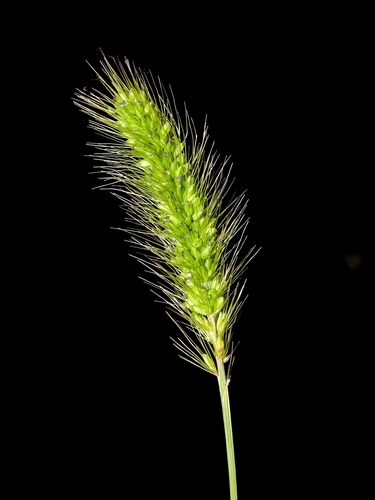
Green Bristle Grass
Setaria viridis
The wild ancestor of foxtail millet, Green Bristle Grass is a summer staple that turns backyard edges into shimmering, golden havens for foraging songbirds.
Quick Identification
Size
Stems reach 20-100 cm (8-40 inches) in height; seed heads are 2-10 cm (0.8-4 inches) long
Colors
Bright green leaves and stems; seed heads are green with yellowish or purplish bristles that turn tawny when dry
Key Features
- Cylindrical 'foxtail' seed head packed with dense bristles
- Leaf blades are flat and rough to the touch
- Bristles (setae) grow in clusters of 1-3 below each spikelet
- Hairless leaf sheaths with a fringe of tiny hairs at the top
When You’ll See Them
Behavior
Green Bristle Grass is a hardy, annual plant known for its rapid growth cycle and incredible resilience. It typically germinates in late spring once the soil warms up, quickly sending up narrow, upright stems that culminate in the iconic 'foxtail' seed head. As a C4 plant, it is exceptionally efficient at photosynthesis in high temperatures and low-moisture conditions, making it a common sight during the height of summer when other grasses might wither.
In the backyard ecosystem, this grass acts as a vital transition plant. It colonizes disturbed soil—like the edges of garden beds or areas where construction has occurred—and provides immediate cover for ground-dwelling insects. While often dismissed as a weed by gardeners, its primary 'behavior' is seed production; a single healthy plant can scatter thousands of seeds, ensuring its return the following year. It interacts with humans mostly through its presence in lawns and gardens, where it is often tolerated as a naturalized wild millet.
EverydayEarth exclusive
Camera Tips
To capture the best footage of Green Bristle Grass, position your camera at a very low 'worm’s-eye' angle, roughly 6 to 10 inches off the ground. This perspective emphasizes the height of the seed heads and makes the grass look like a miniature forest. Because the seed heads sway easily in the slightest breeze, use a camera setting with a high shutter speed or 'Action' mode to prevent motion blur and keep the fine bristles sharp in the frame.
The secret to stunning plant photography is lighting, and for Green Bristle Grass, backlighting is essential. Position your camera so it faces toward the rising or setting sun, with the grass positioned between the lens and the light source. This will cause the translucent bristles (setae) to glow with a 'halo' effect, creating high-contrast, professional-looking imagery. This 'Golden Hour' lighting also makes it easier for AI cameras to distinguish the fine textures of the plant from the background.
If you want to capture wildlife, treat the Green Bristle Grass as a natural lure. It is a favorite food source for Mourning Doves, House Finches, and various sparrows. Set your camera to 'Video' or 'Burst' mode and focus specifically on a cluster of mature seed heads. Birds will often land directly on the stems to pick at the seeds, providing excellent close-up opportunities. Early morning (7:00 AM - 10:00 AM) is the peak time for these foraging interactions.
Consider using a time-lapse setting over a period of 2 to 3 weeks in mid-summer. By securing the camera to a fixed stake, you can record the 'shooting' phase of the grass—where the foxtail emerges from the leaf sheath—and its eventual transition from a vibrant, succulent green to a dry, golden-brown. Ensure the area around the base of the plant is clear of other vibrating foliage to prevent the camera's motion sensor from being triggered by non-target movement.
Similar Species
Species that look similar or are commonly confused with Green Bristle Grass.
Frequently Asked Questions
Record Green Bristle Grass at your habitat
Connect a camera to start building your own species record — AI identifies every visitor automatically.