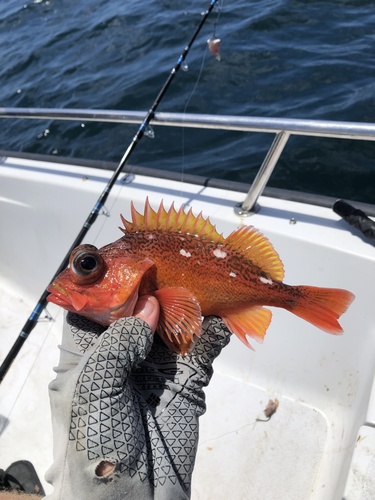
Freckled Rockfish
Sebastes lentiginosus
A master of deep-water camouflage, the Freckled Rockfish is a jewel of the Eastern Pacific's rocky reefs. Discover the secrets of this spotted seafloor specialist through the lens of advanced underwater observation.
Quick Identification
Size
A small rockfish reaching a maximum length of 23-25 cm (9-10 inches).
Colors
Pale pink to white body background heavily covered in small, dark brown or greenish-bronze 'freckles'; darker saddles often visible along the dorsal ridge.
Key Features
- Fine, dense dark spotting over the entire head and body
- Large, prominent eyes characteristic of deep-water dwellers
- Robust head spines with a relatively short snout
- 13 dorsal spines and 12-14 dorsal soft rays
When You’ll See Them
Geographic range
Where Does the Freckled Rockfish Live?
Native to the Eastern Pacific Ocean, the Freckled Rockfish is primarily found along the coast of North America. Its core range extends from the offshore banks of Southern California, particularly around the Channel Islands, southwards to the central coast of Baja California, Mexico. This species is a deep-water specialist, rarely venturing into the shallow kelp forests frequented by other rockfish species.
Basemap © OpenStreetMap contributors
Behavior
The Freckled Rockfish is a cryptic and relatively sedentary species that spends most of its life hovering near the seafloor. Unlike some of its more social relatives that form massive schools, this species is typically solitary or found in very small, loose groups. They are masters of using the complex topography of the reef to remain hidden from larger predators, often tucking themselves into narrow crevices or sitting perfectly still against speckled rock backgrounds where their coloration provides excellent camouflage.
As ambush predators, they exhibit high site fidelity, meaning they tend to stay in the same small area of a reef for long periods. They are not known to be aggressive toward humans, but like most rockfish, they are slow-growing and can live for several decades. Their interactions with humans are limited mostly to deep-sea research and occasional catches by specialized offshore anglers, as they reside far below the typical swimming or snorkeling depths.
EverydayEarth exclusive
Camera Tips
Capturing the Freckled Rockfish requires specialized underwater equipment, as they live at depths well beyond the reach of standard backyard setups. If you are using a drop-camera or a tethered ROV (Remotely Operated Vehicle) near offshore reefs, focus your placement on the 'transition zone' where rocky outcroppings meet the sandy seafloor. These fish love to hover just above the rock-sand interface.
Since these depths are often dark, integrated lighting is essential. Use infrared or dimmable red LEDs if possible; many rockfish are less startled by red light than by harsh white light. To draw a Freckled Rockfish out of a crevice, use a perforated bait box filled with oily fish like sardines or chopped squid. The scent trail (chum) is often more effective than visual lures in the deep, murky light of the benthos.
Set your camera to take short, high-resolution video clips rather than still photos. These fish often remain motionless for minutes at a time, and the subtle movement of their pectoral fins is what helps AI identification software distinguish them from the surrounding rocks. Aim your camera at a 45-degree downward angle toward a rocky ledge to maximize the field of view across their preferred habitat.
Similar Species
Species that look similar or are commonly confused with Freckled Rockfish.
Frequently Asked Questions
Record Freckled Rockfish at your habitat
Connect a camera to start building your own species record — AI identifies every visitor automatically.