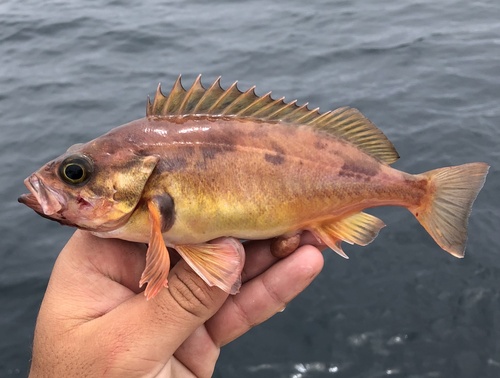
Squarespot Rockfish
Sebastes hopkinsi
Dotted with unique geometric patterns, the Squarespot Rockfish is a social star of the Pacific's deep-water reefs. This schooling fish offers a fascinating glimpse into the complex ecosystems of the California coast.
Quick Identification
Size
Length up to 29 cm (11.4 inches); weight typically under 0.5 kg (1.1 lbs)
Colors
Tan to yellowish-brown body with distinctive dark, square-shaped blotches along the upper back; fins are usually dusky or dark
Key Features
- Distinctive dark square-shaped blotches along the lateral line
- Slender, elongated body compared to other rockfish
- Large eyes adapted for deep-water light levels
- Protruding lower jaw
When You’ll See Them
Geographic range
Where Does the Squarespot Rockfish Live?
The Squarespot Rockfish is a resident of the Eastern Pacific Ocean, primarily found along the western coast of North America. Its range is centered in California, stretching from the Farallon Islands near San Francisco southward to central Baja California, Mexico. It is most abundant in the deep-water reef systems of the Southern California Bight.
Basemap © OpenStreetMap contributors
Behavior
The Squarespot Rockfish is a social, schooling species that congregates in loose groups over rocky substrates. Unlike many of its cousins that prefer to sit still on the bottom, these fish are active 'hoverers.' They spend much of their day suspended in the water column, often several feet above the reef, where they can easily spot passing prey. This behavior makes them a common sight for underwater ROVs and deep-sea divers along the California coast.
In terms of social interaction, they are peaceful and primarily interact within their own schools to reduce the risk of predation. They are slow-growing and long-lived, which is a hallmark of the Sebastes genus. While they are not aggressive toward humans, they are cautious and will retreat into the safety of rocky crevices or deeper water if approached too quickly or if they perceive a threat from larger marine life.
EverydayEarth exclusive
Camera Tips
To capture the Squarespot Rockfish on camera, you will need specialized equipment capable of handling significant depths. Since they are rarely found in the shallows, a remotely operated vehicle (ROV) or a stationary underwater camera with a deep-sea housing is essential. Focus your efforts on areas with 'high relief,' such as vertical rock walls or underwater pinnacles, as these fish prefer structured environments over flat, sandy bottoms.
Lighting is the most critical factor for a clear shot. At the depths where Squarespot Rockfish live, the water filters out red and yellow light, leaving everything looking blue-grey. Use high-powered LED video lights with a high Color Rendering Index (CRI) to restore the natural tan and yellowish hues of the fish. Position your lights at a 45-degree angle away from the lens to minimize 'backscatter'—the reflection of light off particles in the water.
Because Squarespot Rockfish are active during the day, planning your deployment for late morning or early afternoon will provide the best ambient light to supplement your artificial sources. Set your camera to a fast shutter speed (at least 1/125s) to freeze the motion of the school, as they move more frequently than sedentary rockfish species. A wide-angle lens is usually best to capture the scale of the school against the reef backdrop.
While traditional bait isn't recommended, you can use a 'visual lure' to attract their curiosity. A small, shiny piece of metal or a brightly colored ribbon suspended in the current near the camera can draw them in for a closer look. Ensure your camera rig is heavily weighted and secure, as underwater currents can easily shift equipment, potentially damaging the camera or the delicate reef environment.
Similar Species
Species that look similar or are commonly confused with Squarespot Rockfish.
Widow Rockfish
Widow Rockfish lack the distinct square blotches and have a more uniform, dusky-brown to black coloration.
Speckled Rockfish
Speckled Rockfish are covered in many small, fine dots rather than the large, distinct square blotches found on the Squarespot.
Shortbelly Rockfish
Shortbelly Rockfish are much more slender and lack the dark geometric markings on their upper body.
Frequently Asked Questions
Record Squarespot Rockfish at your habitat
Connect a camera to start building your own species record — AI identifies every visitor automatically.