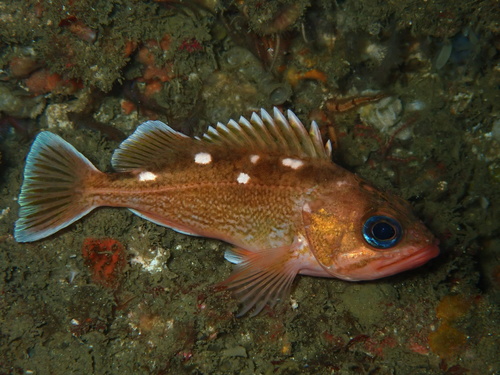
Honeycomb rockfish
Sebastes umbrosus
Adorned with a striking geometric pattern that gives it its name, the Honeycomb rockfish is a master of the Southern California kelp forests. This small but vibrant reef dweller is a favorite for underwater photographers seeking to capture the hidden beauty of the Pacific floor.
Quick Identification
Size
Typically 8-11 inches (20-28 cm) in length; weights up to 1.5 lbs (0.7 kg)
Colors
Dusky pink to orange-brown body with clear white or pink spots on the back and a dark, geometric honeycomb pattern on the lower sides
Key Features
- Distinct dark-edged honeycomb pattern on the lower body and fins
- 5-6 white or pinkish spots along the base of the dorsal fin
- Compact, stocky build with large, expressive eyes
- Dark margins often visible on the dorsal and anal fins
When You’ll See Them
Geographic range
Where Does the Honeycomb rockfish Live?
The Honeycomb rockfish is native to the temperate coastal waters of the Eastern Pacific Ocean. Its primary range is concentrated within the Southern California Bight, extending from Point Conception, California, southward to central Baja California, Mexico. While it is most abundant in the islands and coastal reefs of Southern California, it is also frequently spotted around offshore locations like Guadalupe Island.
Basemap © OpenStreetMap contributors
Behavior
The Honeycomb rockfish is a largely solitary and sedentary inhabitant of the Pacific reef systems. Unlike more gregarious rockfish species that school in open water, this fish is a bottom-dweller that spends much of its time hovering near rocky crevices or tucked within the protective canopy of kelp forests. They are highly territorial and tend to stay within a small home range for most of their adult lives.
As sit-and-wait predators, their behavior is characterized by patience. They can remain nearly motionless for long periods, using their intricate camouflage to blend into the shadows of the reef before lunging at unsuspecting prey. While they are generally shy around divers and large disturbances, they are known to be curious about stationary objects, often peering out from under ledges to investigate changes in their environment.
EverydayEarth exclusive
Camera Tips
Capturing high-quality footage of Honeycomb rockfish requires an underwater camera setup, such as a GoPro in a dive housing or a specialized ROV (Remote Operated Vehicle). For the best results, position your camera near the base of a rocky reef or at the entrance of a small cave. Because these fish are territorial, they often return to the same spot, so a stationary camera placed near a 'home' crevice is likely to capture repeated visits and natural behaviors.
Lighting is the biggest challenge when photographing this species at depth. As water absorbs red light, your footage may appear overly blue or green. Use external video lights (lumes) with a high Color Rendering Index (CRI) to bring out the brilliant orange and pink hues of the fish. Aim the lights at a 45-degree angle away from the lens to minimize 'backscatter'—the reflection of light off particles in the water—which can cloud your image.
To attract a Honeycomb rockfish to your camera's field of view, you can use a small mesh bag filled with chopped squid or oily sardines. Secure the bait bag to a rock about three feet in front of the lens. These fish have a keen sense of smell and will eventually emerge from their hiding spots to investigate. Set your camera to a high frame rate (60fps or higher) to capture their quick, darting strikes at the bait, and use a wide-angle lens to include the surrounding reef habitat for context.
Similar Species
Species that look similar or are commonly confused with Honeycomb rockfish.
Frequently Asked Questions
Record Honeycomb rockfish at your habitat
Connect a camera to start building your own species record — AI identifies every visitor automatically.