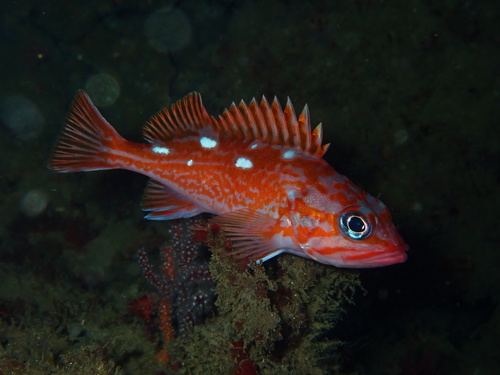
Rosy Rockfish
Sebastes rosaceus
A vibrant jewel of the Pacific deep, the Rosy Rockfish stands out with its striking pink scales and mottled purple markings. This secretive reef dweller is a favorite for underwater explorers and coastal observers alike.
Quick Identification
Size
Typically 20-30 cm (8-12 inches), reaching a maximum of 36 cm (14 inches); weight up to 0.7 kg (1.5 lbs)
Colors
Bright rosy-red or pink body with irregular purple-blue mottling; four to five clear white or pale pink spots along the back
Key Features
- Four to five white/pink spots along the base of the dorsal fin
- Purple-blue mottling on a rosy background
- Small, compact body shape
- Head spines present but relatively low-profile
When You’ll See Them
Geographic range
Where Does the Rosy Rockfish Live?
The Rosy Rockfish is native to the Eastern Pacific Ocean, stretching from the cold waters of Puget Sound in Washington down to central Baja California, Mexico. They are most frequently encountered along the California coast, particularly within the Southern California Bight where rocky bottom structures are most prevalent. While they are a temperate species, they move to deeper, cooler waters in the southern parts of their range.
Basemap © OpenStreetMap contributors
Behavior
Rosy Rockfish are primarily solitary and sedentary dwellers of the deep reef. They are known for their site fidelity, often spending their entire adult lives within a small territory dominated by rocky crevices, ledges, or boulder fields. As ambush predators, they spend much of their time hovering almost motionless just above the substrate, relying on their mottled coloration to blend in with coralline algae and encrusting sponges.
These fish are generally non-aggressive but highly territorial regarding their preferred hiding spots. While they are not known for schooling, they may congregate in high-quality habitats where food and shelter are abundant. In the presence of underwater cameras or ROVs, they often exhibit a 'freeze' response before slowly retreating into a nearby hole if they feel threatened.
EverydayEarth exclusive
Camera Tips
Capturing the Rosy Rockfish requires specialized underwater equipment, as they reside in deep-water habitats far below the reach of standard backyard setups. For those using drop-cameras or stationary reef cams, placement is everything. Position your lens near high-relief structures such as rocky ledges, overhangs, or the base of large boulders. These fish rarely venture into open water, so aiming the camera at the mouth of a crevice is the most effective way to see them.
Because the Rosy Rockfish lives at depths where red light is naturally filtered out by the water, using high-CRI (Color Rendering Index) LED lighting is essential to reveal their true vibrant pink and purple colors. Without supplemental lighting, they will appear dull or grey on camera. Use a wide-angle lens to capture their surrounding habitat, but ensure the camera has a close minimum focal distance, as these fish often hover quite close to interesting objects.
To encourage a Rosy Rockfish to emerge from hiding, you can use a small, mesh bait bag filled with oily fish or squid secured in front of the lens. This 'chum' approach is highly effective for stationary cameras. For the best clarity, deploy your camera during slack tide to prevent heavy currents from vibrating the equipment or stirring up 'marine snow' and sediment that can cloud the image. Time-lapse mode is particularly useful for these sedentary fish, as it allows you to observe their subtle movements and interactions with the reef over several hours.
Similar Species
Species that look similar or are commonly confused with Rosy Rockfish.
Rosethorn Rockfish
Features yellowish-green mottling on the back instead of the Rosy Rockfish's purple-blue patches.
Freckled Rockfish
Smaller in size with a body covered in numerous tiny, dark 'freckles' rather than large mottled patches.
Swordspine Rockfish
Has a much longer second anal spine and lacks the distinctive white spots along the dorsal base.
Frequently Asked Questions
Record Rosy Rockfish at your habitat
Connect a camera to start building your own species record — AI identifies every visitor automatically.