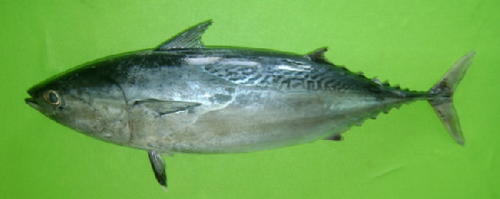
Frigate Tuna
Auxis thazard
The Frigate Tuna is the pocket-rocket of the ocean, a streamlined predator known for its incredible speed and distinctive wavy patterns. A common visitor to warm coastal waters, this mini-tuna offers a thrilling glimpse into the high-energy world of pelagic life.
Quick Identification
Size
Typically 30-45 cm (12-18 inches) in length, reaching a maximum of 65 cm (25.5 inches); weights usually range from 0.5-1.8 kg (1.1-4 lbs).
Colors
Steel-blue upper body with a pattern of 15 or more dark, wavy bars; silvery-white underside with no spots or stripes below the lateral line.
Key Features
- Two dorsal fins separated by a wide gap
- Corselet of scales behind the head that narrows significantly under the second dorsal fin
- Deep blue-to-black wavy markings on the upper back
- Small, torpedo-shaped body with a narrow tail base.
When You’ll See Them
Geographic range
Where Does the Frigate Tuna Live?
Where Does the Frigate Tuna Live? The Frigate Tuna is a truly cosmopolitan species, inhabiting the warm tropical and subtropical waters of all major oceans. From the Atlantic coasts of the Americas and West Africa to the vast reaches of the Indo-Pacific, this species thrives where water temperatures remain consistently high. They are frequently spotted near the coastal waters of the United States (particularly Florida and Hawaii), Japan, Australia, and throughout the Philippines, though they rarely venture into colder temperate zones except during exceptionally warm summers.
Basemap © OpenStreetMap contributors
Behavior
Frigate Tuna are high-velocity, schooling predators that represent some of the fastest swimmers in the ocean's surface layer. They are highly social and are rarely found alone, instead traveling in massive, fast-moving schools that can contain hundreds or even thousands of individuals. This schooling behavior serves as a primary defense mechanism against larger predators like sharks and billfish, while also allowing them to more effectively corral baitfish.
These fish are constantly on the move, a necessity driven by their need to pass oxygen-rich water over their gills through ram ventilation. Because of their high metabolism, they are opportunistic and aggressive feeders. While they are primarily offshore residents, they frequently migrate into coastal waters following seasonal temperature shifts and the movement of prey, making them a seasonal highlight for coastal observers and anglers alike.
EverydayEarth exclusive
Camera Tips
Capturing the Frigate Tuna on camera requires a specialized approach, as these are underwater residents that rarely breach the surface. For coastal residents with docks or piers, the most effective method is utilizing an underwater trail camera or a submersible housing for an AI-powered camera. Mount your camera approximately 1 to 3 meters below the surface, pointing horizontally or slightly upward toward the light. Tuna are highly visual hunters and are often attracted to the silhouette of prey against the sun.
To bring Frigate Tuna into the frame, consider using a 'lure' such as a shiny, reflective metal plate or a slow-release chum bag. The reflection mimics the scales of a baitfish, which can trigger the tuna's curiosity. Because they are exceptionally fast—often moving at speeds that can blur a standard photo—set your camera to its highest possible frame rate or shutter speed. A shutter speed of 1/1000s or faster is ideal for freezing the motion of a passing school.
Timing is critical for these fish. They are most active during the 'crepuscular' hours of dawn and dusk when they move closer to the surface to feed. During these times, the light is softer, which helps reduce the harsh glare on their silvery undersides. If your camera setup allows for AI triggers, program it to look for rapid, horizontal movement patterns, which are characteristic of tuna schools compared to the slower, drifting movement of jellyfish or kelp.
Similar Species
Species that look similar or are commonly confused with Frigate Tuna.
Bullet Tuna
Very similar but has a much wider corselet of scales along the lateral line and a more rounded body shape.
Skipjack Tuna
Much larger than the Frigate Tuna, with distinct dark longitudinal stripes along the belly rather than wavy bars on the back.
Mackerel Tuna
Possesses characteristic dark spots between the pelvic and pectoral fins, which the Frigate Tuna lacks.
Frequently Asked Questions
Record Frigate Tuna at your habitat
Connect a camera to start building your own species record — AI identifies every visitor automatically.