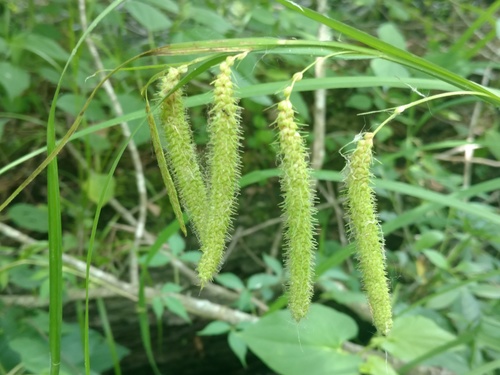
fringed sedge
Carex crinita
With its elegant, drooping seed heads and fountain-like foliage, Fringed Sedge is the 'weeping willow' of the marsh world. This native wetland plant is a favorite for backyard conservationists looking to add movement and vital wildlife cover to damp spaces.
Quick Identification
Size
Stands 2 to 4 feet (60–120 cm) tall; flower spikes are 2 to 4 inches (5–10 cm) long.
Colors
Bright green foliage; flower spikes transition from pale green to a golden or chocolate brown as they mature.
Key Features
- Dense clump-forming (cespitose) growth habit
- Long, pendulous flower spikes that droop gracefully
- Three-sided, triangular stems common to the sedge family
- Reddish-purple tinting at the base of the leaf sheaths
When You’ll See Them
Behavior
Fringed Sedge is a hardy perennial that grows in distinctive, fountain-like clumps. Unlike many aggressive wetland plants, it is relatively non-invasive, preferring to stay in its established tuft while its long, slender leaves arch outward. Its most captivating 'behavior' is the way its heavy seed heads react to the elements; the fringed spikes sway rhythmically in the slightest breeze, a movement that facilitates wind pollination and eventually shakes loose seeds for dispersal by water or gravity.
Ecologically, this plant acts as a silent protector of the shoreline. Its thick root system stabilizes soggy soil against erosion, while the dense overhead canopy of leaves creates a humid microclimate perfect for amphibians and beneficial insects. While it doesn’t seek out human interaction, it is a staple for backyard enthusiasts looking to restore natural drainage areas or create a 'rain garden' that mimics the biodiversity of a wild marsh.
EverydayEarth exclusive
Camera Tips
Capturing the beauty of Fringed Sedge requires a different strategy than photographing fast-moving animals. Because this plant is highly reactive to wind, it is an excellent subject for testing your camera's high-speed video or slow-motion settings. To get the best results, position your camera on a low tripod (about 1–2 feet off the ground) to look up at the drooping spikes against the sky, or place it at eye level to capture the plant's fountain-like architecture. If your AI camera has a time-lapse mode, set it to take a frame every 30 minutes during the spring to watch the flower spikes emerge and slowly begin to arch downward under their own weight.
While the plant itself is stationary, it is a hub for animal activity. To capture 'action' shots, aim your camera at the seed heads during late summer. Small songbirds, such as sparrows and finches, often perch on the stems to pick at the seeds. If your camera is near a water edge where Fringed Sedge grows, you may also capture Wood Ducks or other waterfowl foraging around the base of the plant. Avoid using PIR (motion) sensors alone, as the plant's movement in the wind might trigger too many 'false' recordings; instead, use a combination of time-lapse and motion detection to filter for visiting wildlife.
Lighting is your best friend when photographing this species. The 'fringed' bristles (scales) on the seed heads are somewhat translucent and look spectacular when backlit by the early morning or late afternoon sun. This 'golden hour' lighting will make the yellowish-green spikes appear to glow, highlighting the intricate textures that give the plant its name. If you are using a trail camera, check the lens for water spots frequently, as the high-humidity environments where this sedge thrives can cause condensation or mud splashes from nearby water.
During the winter months, don't pack your camera away. Fringed Sedge provides great structural interest even when dormant. The dried, tan stalks often stand tall through the first few snowfalls, providing a beautiful contrast against a white background. Set your camera to capture the frost crystals that cling to the fringed scales on cold mornings—this provides a macro-level detail that many backyard observers miss.
Similar Species
Species that look similar or are commonly confused with fringed sedge.
Nodding Sedge
Very similar in appearance, but Nodding Sedge (Carex gynandra) has noticeably hairy basal leaf sheaths, whereas Fringed Sedge is smooth.
Bristly Sedge
The seed spikes of Bristly Sedge (Carex comosa) are much denser, stiffer, and look like bristly bottle brushes rather than soft, drooping tassels.
Frequently Asked Questions
Record fringed sedge at your habitat
Connect a camera to start building your own species record — AI identifies every visitor automatically.