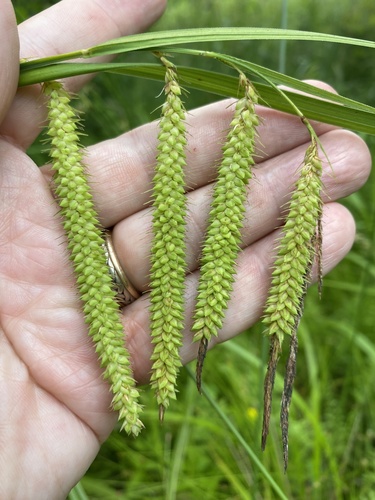
nodding sedge
Carex gynandra
With its elegant drooping seed heads and vibrant green tufts, the nodding sedge is a graceful addition to any damp backyard corner. It serves as a bustling hub for wetland wildlife, from sheltering frogs to hungry songbirds.
Quick Identification
Size
1-4 feet (30-120 cm) tall; clumps 1-2 feet (30-60 cm) wide
Colors
Bright green to yellowish-green foliage; flower spikes turn from light green to golden-tan; lower leaf sheaths often show a reddish-purple tint
Key Features
- Elegant drooping or 'nodding' flower spikes
- Triangular-shaped stems common to sedges
- Densely tufted, clump-forming growth habit
- Long, leaf-like bracts that extend past the flower spikes
When You’ll See Them
Behavior
Nodding sedge is a perennial, clump-forming plant that serves as a cornerstone of wetland ecosystems. Unlike many grasses that spread via aggressive runners, this sedge grows in tidy, concentrated tufts (cespitose). It is wind-pollinated, relying on spring breezes to carry pollen from its male flowers to the female spikes, which eventually droop under their own weight to create the signature 'nodding' appearance.
In the backyard ecosystem, nodding sedge acts as a vital architectural element. It provides structural diversity in rain gardens and damp areas, offering essential cover for amphibians like wood frogs and spring peepers. While it doesn't move across the landscape, it interacts with the environment by stabilizing soil and filtering runoff, making it a silent guardian of water quality in suburban landscapes.
EverydayEarth exclusive
Camera Tips
To capture the best footage of nodding sedge, you need to think beyond the plant itself and focus on the 'visitors' it attracts. Position your camera at a low angle, roughly 12 to 18 inches from the ground, aimed toward the base of a mature clump. This is the prime transit zone for salamanders, frogs, and small mammals like voles that use the dense foliage for protection. Using a wide-angle lens will help you see the full architecture of the plant while catching movement in the surrounding undergrowth.
Lighting is your best friend when filming sedges. For the most dramatic shots, place your camera so the sun is behind the plant during the 'golden hours' of early morning or late afternoon. This backlighting will illuminate the fine hairs and delicate structures of the nodding seed heads, making them glow against the darker background of a forest or garden edge. If your camera has a time-lapse feature, set it to take a photo every 15 minutes during the spring to watch the rapid 'unfolding' of the flower spikes.
Because the foliage of nodding sedge moves easily in the wind, it can often trigger motion sensors and fill your SD card with 'empty' videos. To prevent this, set your camera's sensitivity to 'Medium' and utilize a 'Detection Zone' if your AI software allows, focusing only on the ground area where animals are likely to walk. If you are specifically looking for birds, like swamp sparrows or goldfinches that feed on the seeds, mount the camera on a nearby post at eye-level with the seed heads, ensuring the focus is sharp on the drooping spikes themselves.
During the winter months, don't pack your camera away. The dried stalks and seed heads provide beautiful textures in the snow and continue to attract foraging birds. Keep your camera in a 'Hybrid' mode (photo and video) during this time to capture the quick movements of wintering birds. If you are using an AI-powered camera like those featured on EverydayEarth, make sure the lens is clear of any drooping leaves that might have turned brown and fallen across the sensor during autumn storms.
Similar Species
Species that look similar or are commonly confused with nodding sedge.
Fringed Sedge
Almost identical in appearance, but fringed sedge typically has smoother leaf sheaths and prefers slightly different soil pH.
Graceful Sedge
Smaller and more delicate, with much narrower leaves and thinner, less dense flower spikes.
Tussock Sedge
Forms much larger, elevated mounds or 'tussocks' in standing water, whereas nodding sedge grows in flatter clumps.
Frequently Asked Questions
Record nodding sedge at your habitat
Connect a camera to start building your own species record — AI identifies every visitor automatically.