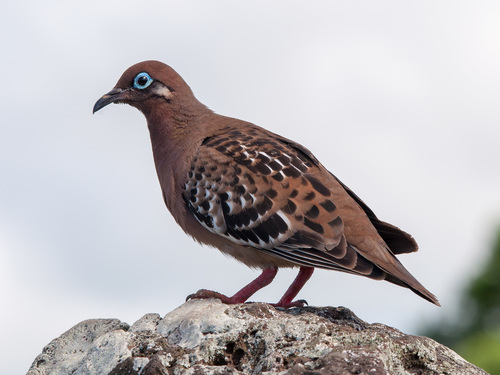
Galápagos Dove
Zenaida galapagoensis
The Galápagos Dove is a jewel of the archipelago, famous for its striking cobalt-blue eye-rings and its remarkably trusting nature. Found nowhere else on Earth, this resilient bird thrives amidst the volcanic rocks and prickly pear cacti of its island home.
Quick Identification
Size
Length of 18–23 cm (7–9 inches); wingspan of 30–35 cm (12–14 inches); weight 65–90 g (2.3–3.2 oz).
Colors
Dark reddish-brown upperparts with black spots; pinkish-buff underparts; iridescent green/bronze neck patch; bright cobalt-blue eye-ring; red-to-pink legs.
Key Features
- Vibrant cobalt-blue ring of skin surrounding each eye
- Bright reddish-pink legs and feet
- Black spots on wings with a white stripe visible when wings are folded
- Small, stocky build with a relatively short tail.
When You’ll See Them
Geographic range
Where Does the Galápagos Dove Live?
Native to the South American region, the Galápagos Dove is found exclusively within the Galápagos Archipelago of Ecuador. This endemic species has established itself across nearly all the major islands, thriving in the lower, drier elevations. Because it is a non-migratory resident, these doves can be spotted year-round throughout the islands' unique volcanic landscapes.
Basemap © OpenStreetMap contributors
Behavior
The Galápagos Dove is remarkably known for its lack of fear toward humans, a trait common among many Galápagos endemics that evolved without significant terrestrial predators. These birds are predominantly ground-dwellers, spending most of their day walking along the volcanic soil or rocky outcrops in search of food. They are often seen in pairs or small groups, moving with a characteristic rhythmic bobbing of the head.
While they are capable fliers, they prefer to escape danger by running or taking short, low-altitude flights. During the breeding season, which typically aligns with the rainy season, males perform subtle bowing displays to attract mates. They are also known for a clever 'broken-wing' distraction display to lure potential predators away from their nests, which are often built in rock crevices or abandoned mockingbird nests to avoid the intense sun.
EverydayEarth exclusive
Camera Tips
To capture the Galápagos Dove on a backyard or trail camera, placement is everything. Because these birds are almost exclusively ground-foragers, you should position your camera very low to the ground—no more than 6 to 12 inches high. Angle the lens slightly upward or keep it level with the horizon to capture their intricate facial details and the striking blue eye-ring. Since they are notoriously tame, you can often get the camera much closer than you would with other bird species without spooking them.
If you are in a permitted area to attract them, water is the ultimate lure. In the arid Galápagos environment, a shallow stone basin or a slow-dripping water source is irresistible. Placing your camera near a patch of Opuntia cactus is also a winning strategy, as the doves frequently visit these plants for fallen fruit and seeds. They are most active during the cooler parts of the day, so set your camera to capture high-trigger frequency during the early morning and late afternoon hours.
Because the volcanic environment can have high-contrast lighting, try to position the camera in a spot that receives filtered light or use a camera with a high dynamic range (HDR) setting to prevent the bright white wing markings from blowing out in the sun. If your camera has a 'macro' or close-focus mode, enable it; these doves are curious and may walk within inches of the lens, providing spectacular high-resolution portraits that show off their iridescent neck feathers.
Similar Species
Species that look similar or are commonly confused with Galápagos Dove.
Frequently Asked Questions
Record Galápagos Dove at your habitat
Connect a camera to start building your own species record — AI identifies every visitor automatically.