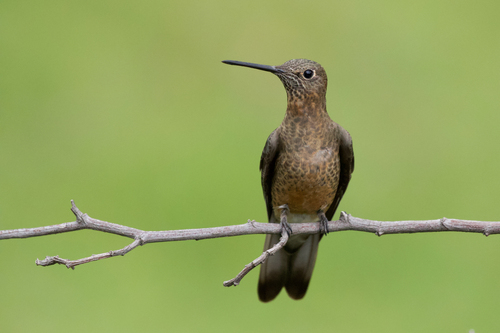
Giant Hummingbird
Patagona gigas
The Giant Hummingbird is a true marvel of the Andes, standing as the largest hummingbird in the world with the wingspan of a starling and the resilience to thrive in the thin air of the high mountains.
Quick Identification
Size
Length of 21–23 cm (8.3–9.1 in) with a wingspan of roughly 21 cm; weighs between 18–24 g (0.6–0.8 oz).
Colors
Muted olive-brown and gray plumage; white rump patch; creamy to cinnamon underparts; blackish wings and tail.
Key Features
- Extraordinary size, comparable to a European Starling
- Slow, deliberate wingbeats resembling a swift or swallow
- Large, conspicuous white patch on the rump
- Long, straight black bill
When You’ll See Them
Geographic range
Where Does the Giant Hummingbird Live?
Native to the rugged spine of the South American Andes, the Giant Hummingbird is a high-altitude specialist found primarily in the mountain ranges of Ecuador, Peru, Bolivia, Chile, and Argentina. While northern populations are generally sedentary, the southern subspecies is known to migrate northward toward the equator during the austral winter to avoid the harshest alpine conditions.
Basemap © OpenStreetMap contributors
Behavior
Despite its name, the Giant Hummingbird is a master of high-altitude flight, though its movements are notably different from its smaller relatives. Instead of the typical high-frequency hum of most hummingbirds, this species has a slower wingbeat frequency—averaging only 10–15 beats per second—which gives it a flight pattern more reminiscent of a swift or a swallow. They are highly territorial and will aggressively defend nectar sources from other birds, often perching prominently on high branches to survey their domain.
These birds are remarkably hardy, adapted to the thin air and cold nights of the Andes. To survive freezing temperatures, they are known to enter a state of torpor, significantly lowering their metabolic rate and body temperature overnight. While they are capable of hovering to feed, their large size often leads them to cling to flowers or use their sturdy feet to perch while drinking nectar, a behavior less common in smaller, more agile hummingbird species.
EverydayEarth exclusive
Camera Tips
Capturing the Giant Hummingbird requires a different strategy than smaller species because of its size and slower flight path. Position your camera 4 to 6 feet away from large-belled flowers like Agave, Puya, or Eucalyptus, as these are their preferred feeding stations. Because they are significantly larger than other hummingbirds, ensure your camera's field of view is wide enough to capture their 8-inch wingspan without clipping the edges of the frame.
Set your trigger speed to the highest sensitivity possible. While their wingbeats are slower than other hummingbirds, they are still fast enough to cause motion blur in low light. For the best results, use a camera with a fast shutter speed or a high-frame-rate video mode. Placing your camera at eye level with the top of a flowering shrub is ideal, as they prefer to approach flowers from above and may even perch on a branch to feed rather than hovering constantly.
If you are using a backyard feeder to attract them, choose one with large, sturdy perches. Unlike tiny hummingbirds that can hover effortlessly for long periods, the Giant Hummingbird often looks for a place to land while it drinks. Early morning light provides the best illumination for their subtle brown and cinnamon feathers, which can appear dull in harsh midday sun or deep shade. If you are in a migratory zone, aim to have your cameras active during the transition months of March and September.
Similar Species
Species that look similar or are commonly confused with Giant Hummingbird.
Frequently Asked Questions
Record Giant Hummingbird at your habitat
Connect a camera to start building your own species record — AI identifies every visitor automatically.