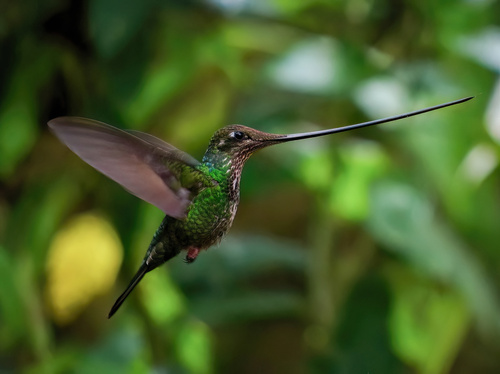
Sword-billed Hummingbird
Ensifera ensifera
Meet the only bird in the world with a beak longer than its own body. A high-altitude specialist of the Andes, the Sword-billed Hummingbird is a stunning example of nature's extreme engineering.
Quick Identification
Size
Total length 21–25 cm (8.3–9.8 in) including bill; bill length 8–12 cm (3.1–4.7 in); weight 10–15 g (0.35–0.53 oz)
Colors
Bronzy-green upperparts, coppery-brown head, and dark green underparts; females have white-spotted bellies
Key Features
- Extraordinarily long, slightly upturned black bill longer than the body
- Large body size for a hummingbird
- Bronze-green plumage with a distinct metallic coppery head
- Unique preening behavior using feet rather than the bill
When You’ll See Them
Geographic range
Where Does the Sword-billed Hummingbird Live?
The Sword-billed Hummingbird is a majestic resident of the South American Andes, where it reigns over high-altitude landscapes. Its range spans the mountain chain from western Venezuela and Colombia through Ecuador and Peru, extending as far south as northern Bolivia. You will primarily encounter this specialist in the temperate zones and cloud forests between the tree line and the paramo, often visiting garden edges where its favorite deep-tubed flowers are cultivated.
Basemap © OpenStreetMap contributors
Behavior
The Sword-billed Hummingbird is a marvel of evolutionary specialization. Because its bill is longer than its entire body, it cannot preen itself like other birds. Instead, it must use its feet to scratch and groom its feathers, often spending long periods perched on high branches to perform this delicate maintenance. Despite its awkward-looking proportions, it is a highly agile flyer, capable of hovering with precision to access nectar sources that no other bird can reach.
These birds are generally solitary and can be quite territorial around their favorite feeding patches. They are most famous for their coevolution with long-tubed flowers; the bird gets a private food source, and the plant gets a dedicated pollinator. While they are not overly shy around humans, they are primarily found in high-altitude habitats where they move between forest edges and mountain gardens in search of blooming flowers.
EverydayEarth exclusive
Camera Tips
To capture the Sword-billed Hummingbird on camera, you must focus on its food source. Standard hummingbird feeders with flat ports are often difficult for this species to use comfortably; instead, position your camera near stands of Passiflora mixta (Passionflower) or Brugmansia (Angel's Trumpet). Place your camera about 4 to 6 feet high, angled slightly upward to catch the bird as it hovers beneath these hanging, tubular blooms. Because the bill is so long, you need a wider depth of field than usual to keep both the tip of the beak and the bird’s eye in sharp focus.
Since these birds inhabit high-altitude cloud forests where light can be dim and misty, a camera with good low-light performance is essential. Set a fast shutter speed—at least 1/2000th of a second—if you want to freeze the wing motion, or use a slower shutter with a flash to highlight the iridescent green feathers. For trail cameras, look for models with a 'fast trigger' or 'burst mode' to ensure you don't just catch a tail feather as the bird zips in and out of the frame.
The best time for photography is mid-morning when the mist begins to lift but the flowers are still heavy with nectar. If you are using a backyard setup in the Andes, consider planting a 'nectar corridor' of native long-tubed plants to encourage the bird to stick around. Be patient; these birds often have a regular 'trap-line' route, meaning they will return to the same flowers at roughly the same time every day once they discover a reliable source.
Similar Species
Species that look similar or are commonly confused with Sword-billed Hummingbird.
Frequently Asked Questions
Record Sword-billed Hummingbird at your habitat
Connect a camera to start building your own species record — AI identifies every visitor automatically.