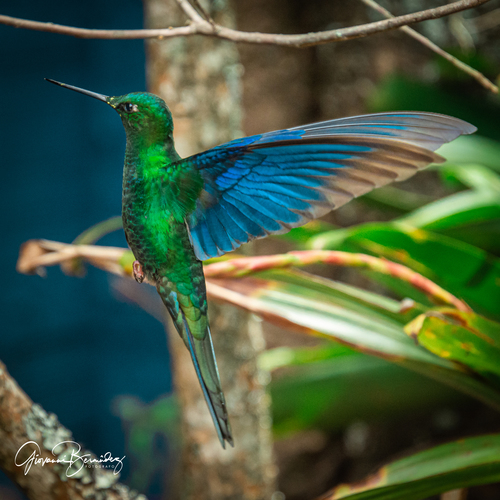
Great Sapphirewing
Pterophanes cyanopterus
One of the largest hummingbirds on the planet, the Great Sapphirewing is a master of the high Andes. Its slow, rhythmic wingbeats and shimmering blue wings make it a breathtaking sight for any backyard observer in its mountain home.
Quick Identification
Size
Length: 15.5–16.5 cm (6.1–6.5 in); Weight: 9–10 g (0.32–0.35 oz)
Colors
Dark emerald green body; males possess brilliant iridescent sapphire-blue wings; females feature buffy-cinnamon underparts and less intense wing color.
Key Features
- Exceptionally large for a hummingbird
- Striking iridescent sapphire-blue wings on males
- Relatively slow, rhythmic wingbeats
- Straight black bill of medium length
When You’ll See Them
Geographic range
Where Does the Great Sapphirewing Live?
Native to the soaring heights of the South American Andes, the Great Sapphirewing is a high-altitude specialist that occupies a rugged mountain corridor. Its core range stretches through the humid temperate zones of Colombia, Ecuador, Peru, and into northern Bolivia. You will typically find them at the edges of stunted montane forests where the tree line meets the open paramo grasslands, rarely descending into the warmer tropical lowlands.
Basemap © OpenStreetMap contributors
Behavior
The Great Sapphirewing is a mountain specialist, known for its remarkably large size and unusually slow wingbeats for a hummingbird. Unlike its smaller, frantic relatives, this species often appears to glide or flap with a rhythmic cadence more reminiscent of a swift. It is highly territorial near rich nectar sources but can be surprisingly approachable in gardens or at high-altitude feeders.
Interestingly, because of its size and the cold mountain air, it often employs a strategy called 'perch-feeding,' where it clings to a flower or branch while drinking nectar rather than hovering continuously. This conserves vital energy in the thin Andean atmosphere. While generally solitary, several may congregate at a particularly lush flowering tree, though they will frequently engage in aerial chases to defend their preferred feeding patches.
EverydayEarth exclusive
Camera Tips
To capture the stunning blue of a Great Sapphirewing's wings, lighting is your most critical factor. The iridescent feathers only 'glow' when light hits them at a specific angle relative to your camera lens. Position your camera with the sun at its back, facing a frequent perch or a group of tubular flowers like Fuchsia. Early morning sun is often best as it sits low on the horizon, illuminating the bird's underside and wings more effectively.
Because these birds are larger and have a slower wingbeat than smaller hummingbirds, you have a better chance of getting a sharp image without a massive flash setup. However, to freeze the wing motion, you should set your camera's shutter speed to at least 1/2000s. If your AI-powered camera allows for custom trigger zones, focus on the 'landing zone' near a flower rather than the flower itself, as these birds often pause for a moment before feeding.
If you are setting up a trail camera in their natural habitat, look for Puya plants. These giant bromeliads are a magnet for Sapphirewings. Mount the camera about 4 to 5 feet off the ground, angled slightly upward toward the flower spikes. In high-altitude environments, remember that batteries drain significantly faster due to the cold, so using a solar panel attachment or high-capacity lithium batteries is highly recommended for consistent monitoring.
Similar Species
Species that look similar or are commonly confused with Great Sapphirewing.
Giant Hummingbird
Even larger, but lacks the iridescent blue wings; has a brownish, duller overall appearance.
Sword-billed Hummingbird
Similar size and habitat, but easily identified by its bill, which is longer than its entire body.
Golden-breasted Puffleg
Much smaller with white 'cotton ball' leg tufts and a glittering gold-green chest.
Frequently Asked Questions
Record Great Sapphirewing at your habitat
Connect a camera to start building your own species record — AI identifies every visitor automatically.