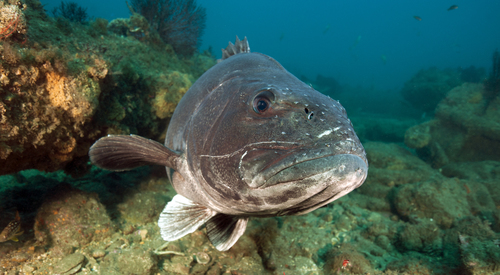
Giant Sea Bass
Stereolepis gigas
The Giant Sea Bass is a gentle, curious titan of the California kelp forests. Once nearly extinct, these massive 'puppies of the sea' are making a slow but steady comeback in the North Pacific.
Quick Identification
Size
Up to 2.5 metres (8.2 feet) in length and weighing as much as 255 kg (560 lbs).
Colors
Adults are typically a solid dark grey, charcoal, or brownish-black. Juveniles are strikingly different, featuring bright orange bodies with large, prominent black spots.
Key Features
- Enormous, bulky body with a massive head and mouth
- Small dark spots along the sides (fade with age)
- Dorsal fin consists of a spiny forward section and a soft-rayed rear section
- Large, rounded pectoral and tail fins
When You’ll See Them
Geographic range
Where Does the Giant Sea Bass Live?
The Giant Sea Bass is a signature species of the Eastern North Pacific Ocean. Its native range stretches from the cool waters of Humboldt Bay in Northern California down to the tip of Baja California and into the Gulf of California in Mexico. They are most commonly observed in the temperate waters of the Southern California Bight, particularly around the Channel Islands where protected kelp forests provide ideal hunting grounds.
Basemap © OpenStreetMap contributors
Behavior
Giant Sea Bass are the undisputed kings of the kelp forest, known for their slow-moving, majestic presence. Despite their intimidating size, they are remarkably curious and relatively docile around humans, frequently approaching divers to investigate them. They are ambush predators that utilize a 'suction-feeding' method, rapidly opening their enormous mouths to create a vacuum that pulls prey inside instantly.
These fish are generally solitary but exhibit social behaviors during the summer months when they congregate in specific rocky reef areas for spawning. They are extremely long-lived, with some individuals estimated to reach over 75 years of age. Their slow growth and late reproductive maturity make their populations particularly sensitive to environmental changes and historical overfishing.
EverydayEarth exclusive
Camera Tips
Capturing the Giant Sea Bass requires specialized underwater camera equipment, as this species lives strictly in marine environments. To get the best footage, place your camera housing on a weighted tripod at the edge of a kelp forest clearing or near a rocky pinnacle. These giants often patrol the 'corridors' between kelp stands, so orienting your camera to face a clear patch of water will help the AI-detection software identify their massive silhouette without obstruction from swaying seaweed.
Because these fish are naturally inquisitive, they may actually approach your camera to investigate. Using a wide-angle lens is essential to capture the full scale of an adult fish, as they are often too large for standard focal lengths when they swim close. Avoid using high-intensity artificial lights during the day, as the 'backscatter' from floating particles in the Pacific can cloud the image; natural ambient light filtered through the kelp canopy provides the most authentic and clear view of their dark coloration.
For the best chance of a sighting, schedule your camera deployments during the summer spawning season (June through August) when these fish gather in predictable locations. Set your camera to record high-frame-rate video rather than just stills, as the subtle movement of their fins and the way they 'hover' in the current is a key identification feature. Ensure your housing is rated for at least 40 metres of depth and is securely anchored to the seabed to withstand the strong Pacific surges.
Similar Species
Species that look similar or are commonly confused with Giant Sea Bass.
Frequently Asked Questions
Record Giant Sea Bass at your habitat
Connect a camera to start building your own species record — AI identifies every visitor automatically.