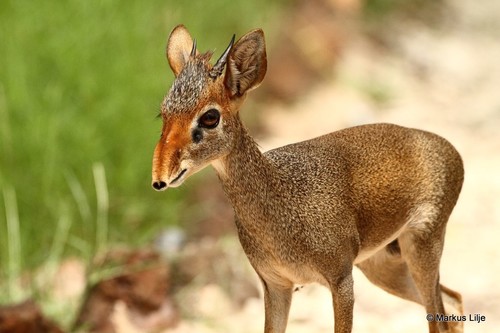
Günther's Dik-dik
Madoqua guentheri
Meet one of Africa's smallest and most charming antelopes, known for its wiggly snout and monogamous lifestyle. The Günther's Dik-dik is a master of camouflage in the arid scrublands of the East.
Quick Identification
Size
Length: 50–70 cm (20–28 in); Height: 32–40 cm (13–16 in); Weight: 3.5–5.5 kg (7.7–12.1 lb)
Colors
Grizzled yellowish-gray to reddish-brown coat with a white underbelly, tan legs, and a distinctive tuft of hair on the forehead.
Key Features
- Elongated, flexible proboscis-like snout
- Pointed tuft of hair on the forehead
- Small, straight, ringed horns on males
- Large, dark eyes with a pale surrounding ring
When You’ll See Them
Sightings on EverydayEarth
Jun 23, 2026
A small herd of Günther's Dik-diks is gathered in the deep shade of a tree to escape the morning sun. The small antelopes remain largely still, with a few individuals occasionally turning their heads or shifting position as they rest in the woodland environment.
Jun 19, 2026
Three Guenther's Dik-Diks are seen resting in the dry grass. One individual stands alert, occasionally turning its head and twitching its large ears, while two others remain lying down, partially camouflaged by the vegetation. The wind is notably strong, causing the surrounding grass and the animals' fur to ripple.
Jun 14, 2026
A pod of hippopotamuses is gathered in the center of the watering hole, with several individuals surfacing and shifting positions in the water. On the far left bank, a tiny Günther's dik-dik emerges from the brush and moves cautiously along the shoreline. Egyptian geese are also visible, both perched on logs in the water and foraging along the banks.
Jun 8, 2026
A small Guenther's Dik-Dik wanders through the tall grass, pausing briefly to graze before continuing its path across the clearing.
May 23, 2026
A Guenther's Dik-dik moves cautiously through the lush green grass and scrub. It pauses briefly to scan its surroundings before continuing its path across the woodland floor, passing behind a large fallen log.
May 15, 2026
A Günther's Dik-dik is visible in the lower right foreground, standing near the edge of the vegetation. It is alert, moving its head to scan the environment, with its eyes reflecting the camera's infrared light.
Geographic range
Where Does the Günther's Dik-dik Live?
This diminutive antelope is native to the Horn of Africa and the broader East African region. Its core population resides within the arid lowlands of southern Ethiopia, Somalia, and northern and eastern Kenya, extending into parts of South Sudan and northeastern Uganda. In these dry landscapes, the Günther's Dik-dik thrives where thickets and scrub provide both food and protection from the harsh sun and numerous predators.
Basemap © OpenStreetMap contributors
Recorded on EverydayEarth
Behavior
Günther's Dik-diks are remarkably shy and alert antelopes that live in stable, monogamous pairs. They are highly territorial, frequently marking their boundaries with secretions from their preorbital glands and communal dung heaps. Because they are so small, they spend much of their time hidden within thick brush to avoid predators, emerging primarily during the cooler hours of the day.
These tiny ungulates are browsers, meticulously picking out the most nutrient-rich parts of desert plants. They are well-adapted to arid environments and rarely need to drink water, obtaining most of their hydration from the vegetation they consume. When startled, they perform a zig-zagging flight pattern, emitting a whistling 'zik-zik' sound that gives them their name.
EverydayEarth exclusive
Camera Tips
To successfully capture a Günther's Dik-dik on camera, placement is everything. These animals are very short, standing only about 14 inches at the shoulder, so your camera must be mounted low—roughly 12 to 18 inches off the ground. Angle the lens slightly upward or keep it level with their eye line to catch the detail of their unique snout and forehead tuft. Because they are creatures of habit, look for established 'latrines' (communal dung heaps) or narrow game trails through thickets, as they use these paths daily to navigate their territory.
Timing is crucial for the best shots. While they can be active during the day if it's overcast, they are most predictable during the 'golden hours' of dawn and dusk. Ensure your camera has a fast trigger speed and high-quality infrared night vision, as they often move through the shadows. Avoid using white flash, which will likely spook these high-strung animals and prevent them from returning to the spot. Setting your camera to 'Burst Mode' or a short video clip is highly recommended to capture their nervous, twitchy movements and grooming behaviors.
If you are setting up in a backyard or lodge environment in East Africa, dik-diks are often attracted to salt licks or certain fruiting bushes. However, the best 'lure' is simply providing a safe, quiet corridor of native acacia or scrub. Keep domestic dogs away from the camera area, as dik-diks are extremely sensitive to predators and will abandon a site if they feel threatened. In the dry season, a small, ground-level water basin can be a magnet for them; even though they don't drink often, they will visit to investigate the moisture and associated plant growth.
Similar Species
Species that look similar or are commonly confused with Günther's Dik-dik.
Frequently Asked Questions
Record Günther's Dik-dik at your habitat
Connect a camera to start building your own species record — AI identifies every visitor automatically.