Golden Leather Fern
Acrostichum aureum
A true titan of the wetlands, the Golden Leather Fern stands as a leathery, salt-defying giant. Its massive fronds and shimmering golden spores create a Jurassic-scale backdrop for the world's most resilient coastal wildlife.
Quick Identification
Size
A massive fern with fronds reaching 1.5 to 3.5 meters (5 to 11.5 feet) in height and up to 40 cm (15 inches) in width.
Colors
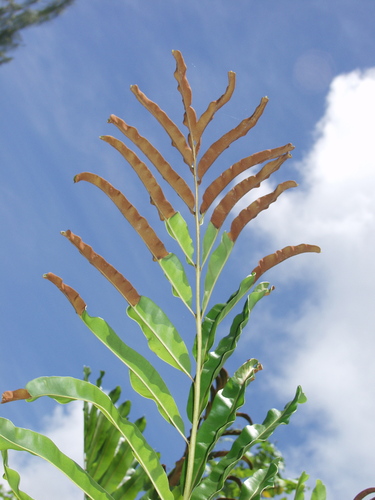
Deep emerald to olive green foliage with a thick, waxy sheen; fertile fronds feature a distinctive golden-brown to rust-colored underside due to dense spore coverage.
Key Features
- Gigantic upright fronds that can exceed 10 feet in height
- Leathery, thick texture resistant to salt and wind
- Golden-brown velvety spores covering the undersides of top leaflets
- Found exclusively in wet, brackish, or saline environments
When You’ll See Them
Behavior
The Golden Leather Fern is a hardy 'halophyte,' a plant specifically adapted to survive in salty conditions where most other vegetation would wither. It typically grows in large, dense clumps, creating a wall of greenery that acts as a natural windbreak and erosion control for coastal areas. Unlike many ferns that prefer the damp shadows of a forest floor, this species thrives in full sun and high humidity, making it a dominant feature of mangrove transitions.
Ecologically, it serves as a critical nursery and hiding spot for coastal wildlife. Its thick root masses stabilize muddy banks, while the dense fronds provide shade and protection for crabs, snails, and juvenile fish during high-tide flooding. While it does not move, its growth rate is impressive during the rainy season, quickly reclaiming disturbed land or cleared mangrove patches.
EverydayEarth exclusive
Camera Tips
Capturing the Golden Leather Fern on a trail camera is less about 'trapping' movement and more about documenting the incredible lifecycle of a prehistoric-looking plant. To capture the most dramatic footage, set your camera to time-lapse mode. Position the camera about 3 feet off the ground, angled slightly upward to frame a single 'crozier' (fiddlehead) as it unfurls. Over the course of 7-14 days, you will see the tightly coiled head expand into a massive, leathery leaf—a process that looks truly alien on high-speed playback.
Lighting is your best friend with this species. Because the fronds have a thick, waxy cuticle, they can be highly reflective. Aim to position your camera facing north or south to avoid direct glare from the rising or setting sun. The best images are captured during the 'golden hour' (shortly after sunrise or before sunset) when the light hits the golden-brown spore patches on the undersides of the fronds, making them appear to glow from within.
If you are looking to capture wildlife interaction, place the camera at the base of a fern clump near the water's edge. Many coastal mammals, such as raccoons or marsh rabbits, use the dense base of the Golden Leather Fern as a highway to stay out of sight of aerial predators. Use a wide-angle setting to capture both the plant and any visitors weaving through the stalks. Avoid using heavy lures or baits directly on the plant, as the salt-sensitive ecosystem is fragile; instead, rely on natural game trails that lead into the fern thicket.
Check your equipment frequently if placing it in the fern's natural habitat. The brackish, humid environment where these ferns thrive is notorious for corroding electronics and fogging lenses. Use a desiccant pack inside your camera housing and ensure all seals are lubricated with silicone grease to prevent the salt air from ruining your gear. If you are monitoring growth in a backyard pond, a standard garden stake is usually enough to support a lightweight AI camera for long-term observation.
Similar Species
Species that look similar or are commonly confused with Golden Leather Fern.
Frequently Asked Questions
Record Golden Leather Fern at your habitat
Connect a camera to start building your own species record — AI identifies every visitor automatically.