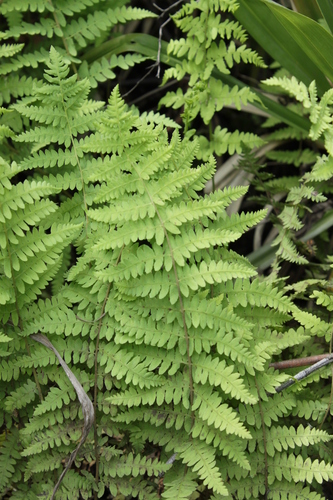
Swamp Fern
Thelypteris confluens
A delicate yet hardy inhabitant of the water's edge, the Swamp Fern creates lush green carpets that serve as a sanctuary for wetland wildlife. Its unique ability to thrive in saturated soils makes it a cornerstone of marshy backyard ecosystems.
Quick Identification
Size
Fronds typically reach 25–60 cm (10–24 inches) in length and 5–15 cm (2–6 inches) in width.
Colors
Bright lime-green to deep emerald fronds; brownish-yellow stems (stipes); underside spores appear as dark brown or black dots when mature.
Key Features
- Fronds are pinnate-pinnatifid (deeply lobed but not fully divided)
- Fertile fronds have margins that roll inward to protect spore cases
- Long, creeping rhizomes that allow for dense colony formation
- Stems are slender and slightly brittle
When You’ll See Them
Behavior
The Swamp Fern is a resilient perennial that spreads primarily through an underground network of rhizomes. Unlike many other ferns that grow in discrete clumps, this species tends to form expansive, lush carpets across wet ground. It plays a vital role in its ecosystem by stabilizing soggy soil and providing a dense canopy for small invertebrates and amphibians.
As a deciduous species, its fronds emerge in early spring, unfolding from tightly coiled 'fiddleheads.' Throughout the summer, it produces two types of fronds: sterile ones for energy production and fertile ones for reproduction. The fertile fronds are easily distinguished by their slightly taller stature and the way their leaf edges curl over the spore-bearing sori on the underside.
EverydayEarth exclusive
Camera Tips
Capturing the Swamp Fern with an AI-powered camera requires a shift in strategy from tracking animals to capturing growth and environmental interaction. To document its lifecycle, set your camera to a time-lapse mode. Positioning the lens about 12-18 inches from the ground in early spring will allow you to capture the dramatic 'unfurling' of the fiddleheads, a process that is visually stunning when compressed into a short video.
Because these ferns grow in saturated soil, use a tripod with wide 'feet' or a specialized stake to prevent the camera from sinking or tilting over time. Direct sunlight can wash out the delicate green of the fronds; for the best color saturation, aim for 'golden hour' light (early morning or late afternoon) or slightly overcast days. This lighting highlights the intricate vein patterns and the texture of the fertile fronds' rolled edges.
Swamp Ferns are hotspots for wildlife activity. Position your camera at a low angle (around 5-10 inches) facing a cluster of ferns to catch frogs, salamanders, or dragonflies that use the fronds for cover or hunting perches. If your camera has a macro setting or high-resolution trigger, focus on the undersides of the fronds in late summer to document the maturation of the brown spore cases (sori).
Similar Species
Species that look similar or are commonly confused with Swamp Fern.
Marsh Fern
Extremely similar but often lacks the distinct rolled margins on fertile fronds found in T. confluens.
Sensitive Fern
Has much wider, coarser leaf segments and separate, woody-looking fertile stalks.
Cinnamon Fern
Grows in large, circular clumps rather than spreading carpets and features tall, cinnamon-colored fertile spikes.
Frequently Asked Questions
Record Swamp Fern at your habitat
Connect a camera to start building your own species record — AI identifies every visitor automatically.