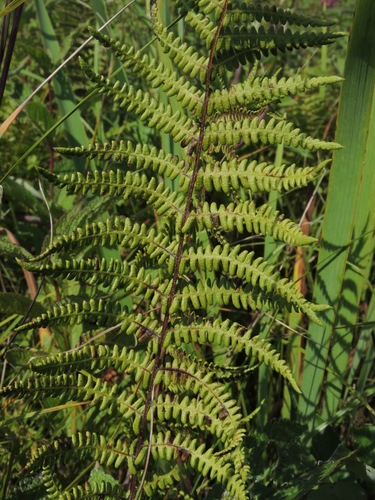
marsh fern
Thelypteris palustris
A vibrant anchor of the wetlands, the marsh fern brings a splash of lime-green elegance to any damp corner of your yard. This resilient native species is not just a visual delight; it’s a vital habitat builder for rare moths and secretive amphibians.
Quick Identification
Size
Fronds typically reach 12–30 inches (30–75 cm) in height and 3–7 inches (7–18 cm) in width
Colors
Bright lime green to pale yellowish-green; fertile fronds may appear darker due to spore cases; autumn foliage turns light brown
Key Features
- Fronds are twice-cut (bipinnatifid) with 10-25 pairs of leaflets
- Long, creeping black rhizomes that form dense colonies
- Margins of fertile leaflets roll inward to protect spores
- Straw-colored, mostly hairless stems (stipes)
When You’ll See Them
Behavior
The marsh fern is a colony-forming perennial that spreads primarily through its long, slender black rhizomes. Unlike many ferns that grow in tight clumps, the marsh fern's creeping nature allows individual fronds to pop up several inches apart, creating a lush, carpet-like appearance in wet environments. This growth habit makes it an excellent stabilizer for soil in boggy areas or along the edges of ponds.
As a deciduous species, it undergoes a dramatic seasonal cycle. In early spring, fiddleheads emerge from the mud, uncurling into sterile fronds first, followed by fertile fronds later in the summer. It provides essential cover for small amphibians and is the exclusive host plant for the marsh fern moth (Fagitana littera), making it a high-value species for biodiversity-focused backyard gardeners.
EverydayEarth exclusive
Camera Tips
Capturing the marsh fern effectively requires a focus on plant phenology—the timing of its biological life stages. Set your camera to a time-lapse mode during late April or May to capture the 'fiddleheads' uncurling. Position the camera on a low tripod or ground mount, roughly 12 inches from the soil, angled slightly upward. This perspective emphasizes the elegant spiral of the emerging fronds against the backdrop of the wetlands.
Because this fern is the only host for the marsh fern moth, your camera setup can pull double duty. Use a macro lens or a close-focus setting and place the camera near the underside of the fronds where the moth larvae feed. If your camera has a 'motion trigger' for small insects, focus on the fertile fronds during the evening hours of mid-summer, as the adult moths may visit the plant to lay eggs.
Lighting is crucial for ferns, as their translucent green leaves glow beautifully in 'golden hour' light. Aim for backlighting (positioning the sun behind the fern relative to the camera) during the early morning or late afternoon. This will highlight the intricate venation of the pinnae and the fuzzy texture of the stems. If using an AI-powered camera in a backyard setting, place it near a water feature or drainage area where the fern thrives to capture the birds and amphibians that use the dense fronds as cover.
Similar Species
Species that look similar or are commonly confused with marsh fern.
New York Fern
The New York fern has fronds that taper at both the top and the bottom, whereas the marsh fern only tapers at the top.
Sensitive Fern
Sensitive ferns have much broader, leathery leaflets that are not as deeply divided as the delicate, feathery fronds of the marsh fern.
Cinnamon Fern
Cinnamon ferns grow in massive, distinct clumps and produce a central 'cinnamon-colored' fertile spike, unlike the creeping marsh fern.
Frequently Asked Questions
Record marsh fern at your habitat
Connect a camera to start building your own species record — AI identifies every visitor automatically.