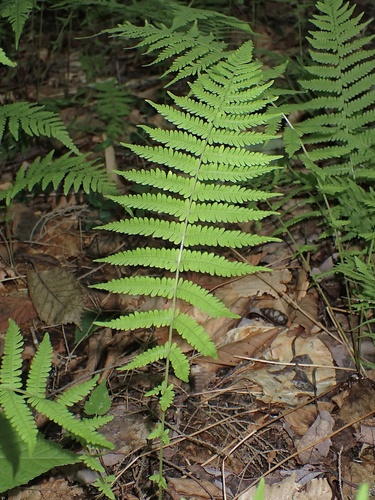
New York fern
Amauropelta noveboracensis
Famous for the mnemonic 'New Yorkers taper at both ends,' this bright green fern creates lush, feathery carpets across eastern woodlands. Its delicate, yellow-green fronds are a hallmark of healthy, moist acidic forests.
Quick Identification
Size
Fronds typically reach 30–60 cm (12–24 inches) in length and 10–15 cm (4–6 inches) in width.
Colors
Bright yellow-green to lime green fronds; stipe (stem) is typically pale green to straw-colored or light brown at the base.
Key Features
- Fronds taper significantly at both the tip and the base
- Yellow-green, delicate foliage
- Twice-pinnate (bipinnatified) leaf structure
- Rhizomatous growth forming dense colonial carpets
- Slightly hairy rachis (midrib) on the underside
When You’ll See Them
Behavior
The New York fern is a social species of the plant world, known for its ability to form extensive, lush colonies that carpet the forest floor. Unlike many ferns that grow in distinct clumps, this species spreads via slender, creeping rhizomes, effectively 'marching' across a landscape to claim territory. In its preferred habitat, it can become the dominant ground cover, creating a soft, feathered texture beneath the woodland canopy.
While it doesn't 'behave' in the animal sense, it is highly responsive to light and moisture. It is often one of the first plants to signal a change in soil pH or moisture levels in a backyard ecosystem. It also interacts with other species through allelopathy, occasionally releasing chemicals into the soil that can inhibit the growth of certain tree seedlings, specifically black cherry and red maple, which helps it maintain its sunny openings in the forest.
EverydayEarth exclusive
Camera Tips
Capturing the New York fern effectively requires a focus on its unique geometry. Because its most identifying feature is the 'tapering at both ends,' your camera should be positioned to capture a side-profile of a single frond or a top-down view of a small cluster. Place your camera on a low tripod or a ground-mount roughly 1 to 2 feet off the forest floor. This low angle allows the AI to distinguish the smaller leaflets at the bottom of the stem, which is the key diagnostic feature for this species.
Since plants don't move toward bait, use time-lapse settings to capture the 'fiddleheads' unfurling in late April or May. Setting your camera to take one photo every 4–6 hours during the spring will result in a stunning sequence of growth. For the best color saturation, aim for 'Golden Hour' lighting—early morning or late afternoon—when the sun is low. The backlighting will make the translucent, yellow-green fronds appear to glow, highlighting the delicate hairs along the rib.
If you are using a motion-triggered camera, place it in an area where the ferns are known to grow to capture the wildlife that utilizes them. Small mammals like chipmunks or ground-nesting birds often use the dense colonies of New York ferns for cover. Avoid placing the camera in direct, harsh midday sun, as the high contrast can wash out the delicate green hues and make identification difficult for the AI. A cloudy, overcast day provides the best soft, even lighting for plant photography.
Similar Species
Species that look similar or are commonly confused with New York fern.
Hay-scented Fern
Hay-scented ferns only taper at the tip and have a triangular shape, whereas New York ferns taper at both the tip and the base.
Marsh Fern
Marsh ferns have more widely spaced leaflets and the lowest leaflets do not shrink into the tiny 'ears' seen on the New York fern.
Ostrich Fern
Ostrich ferns are much larger (up to 5 feet tall) and grow in vase-like clumps rather than spreading colonial carpets.
Frequently Asked Questions
Record New York fern at your habitat
Connect a camera to start building your own species record — AI identifies every visitor automatically.