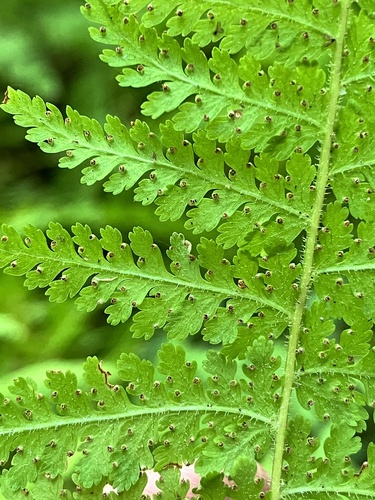
hay-scented fern
Dennstaedtia punctilobula
Transforming the forest floor into a fragrant, lacy carpet, the hay-scented fern is a hardy survivor of the eastern woods. Its delicate appearance belies a rugged nature that thrives even where deer roam and other plants falter.
Quick Identification
Size
Fronds typically range from 1 to 3 feet (30–90 cm) in height and 2 to 4 inches (5–10 cm) in width.
Colors
Bright yellowish-green fronds during the growing season, turning a golden-yellow to pale tan in autumn; stems are light green to straw-colored.
Key Features
- Strong fragrance of freshly mown hay when fronds are crushed
- Delicate, lace-like twice-pinnate fronds
- Fronds covered in fine, sticky glandular hairs
- Creeping growth habit that forms dense colonies
When You’ll See Them
Behavior
The hay-scented fern is a resilient and aggressive colonizer of the forest floor. Unlike many of its more delicate relatives, this species can tolerate a wide range of light conditions, from deep shade to nearly full sun, provided the soil remains somewhat moist. It spreads primarily through an underground network of fast-growing rhizomes, allowing it to form vast, monocultural carpets that can dominate a landscape and prevent other plants from taking root.
This fern plays a significant role in forest ecology due to its chemical defenses. It is highly deer-resistant; in areas where deer populations are high and other plants are over-browsed, the hay-scented fern often becomes the primary ground cover. Furthermore, it is known to be allelopathic, meaning it releases chemicals into the soil that inhibit the germination and growth of certain tree species, particularly black cherry and red maple seedlings.
EverydayEarth exclusive
Camera Tips
Capturing the hay-scented fern on a trail camera requires a different approach than moving wildlife. Since the plant is stationary, use it to create a stunning time-lapse. Secure your camera to a post or tree about 18 to 24 inches off the ground, angled slightly downward to look over the top of the 'fern carpet.' Setting your camera to take one high-resolution photo every day at noon will allow you to compile a sequence showing the fiddleheads emerging in spring and unfurling into the dense, lacy canopy of summer.
Because these ferns are deer-resistant, they often act as natural 'corridors' for other wildlife. Animals like foxes, bobcats, and turkeys frequently use the edges of fern colonies for cover while traveling. Position your camera at the intersection where a fern colony meets a clearing or a different vegetation type. The fine texture of the fronds provides an excellent high-contrast foreground that makes the colors of passing mammals or birds stand out vividly in your shots. Avoid placing the camera too deep inside a tall fern patch, as the fronds may blow in the wind and trigger the motion sensor repeatedly, filling your card with 'ghost' photos.
Lighting is the most critical factor for showcasing the hay-scented fern's unique texture. Try to position your camera so it is side-lit by the morning or late afternoon sun. This low-angle light catches the tiny glandular hairs on the stems and highlights the intricate, serrated edges of the leaflets. If you are using a camera with adjustable settings, a faster shutter speed is recommended for breezy days to prevent the fronds from appearing as a green blur. In late September and October, keep your camera active to catch the spectacular color shift as the ferns turn from green to a glowing, translucent yellow.
Similar Species
Species that look similar or are commonly confused with hay-scented fern.
Frequently Asked Questions
Record hay-scented fern at your habitat
Connect a camera to start building your own species record — AI identifies every visitor automatically.