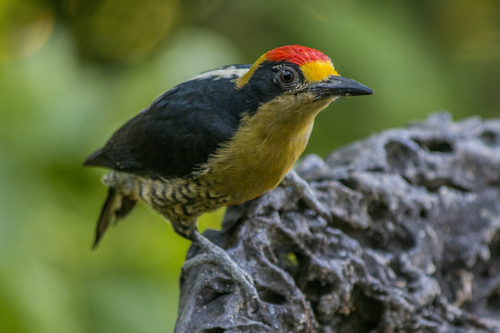
Golden-naped Woodpecker
Melanerpes chrysauchen
A social and vibrant inhabitant of Central America's Pacific slope, the Golden-naped Woodpecker is easily recognized by its shimmering yellow neck and bold ladder-back patterns. This lively bird is a frequent visitor to tropical gardens, where its playful family groups bring both color and character.
Quick Identification
Size
17–19 cm (6.7–7.5 in) long; 50–65 g (1.8–2.3 oz) weight
Colors
Black upperparts with a white-barred central stripe; golden-yellow nape; male has a red crown, while female has a black crown; yellowish-white belly with a red central patch.
Key Features
- Bright golden-yellow patch on the back of the neck
- White forehead and a black mask through the eyes
- Distinctive white barring down the center of a black back
- Red patch on the lower abdomen
When You’ll See Them
Geographic range
Where Does the Golden-naped Woodpecker Live?
The Golden-naped Woodpecker is a tropical resident of Central America, specifically restricted to the Pacific slope of the continent. Its core range spans from southern Costa Rica into western Panama. Within this region, it is most frequently found in the humid lowland forests and foothills of the Osa Peninsula and the Chiriquí highlands.
Basemap © OpenStreetMap contributors
Behavior
In the backyard or garden setting, they are surprisingly bold if fruit is available. They exhibit a 'hitching' movement up tree trunks but spend a significant amount of time on horizontal branches or at the ends of twigs where fruit is most abundant. They are known for cooperative breeding behaviors, where older offspring may assist their parents in protecting the territory and feeding new fledglings.
EverydayEarth exclusive
Camera Tips
To successfully capture the Golden-naped Woodpecker on your AI camera, focus on their love for fruit. While many woodpeckers are attracted to suet, this species is far more likely to visit a platform feeder stocked with halved bananas, plantains, or chunks of papaya. Mount your camera about 5 to 8 feet high, facing a feeder or a known fruiting tree like a Cecropia or wild fig. Because they are social, try to use a wide-angle lens setting to capture multiple birds interacting at once.
Placement is key for identification. To ensure your AI camera correctly identifies the 'golden nape,' position the camera at a 45-degree angle to a vertical trunk or a horizontal branch where they frequent. This profile view highlights the contrast between the red crown and the yellow nape. Set your camera's trigger speed to its fastest setting, as these birds move with quick, jerky motions and may only stay in one spot for a few seconds before fluttering to the next branch.
Lighting in the tropical rainforest can be challenging due to the heavy canopy shadow. If your camera is placed in a shaded area, look for a model with good low-light performance or set it to a higher ISO if manual settings are available. Early morning is their peak activity time; ensure your camera is positioned so the rising sun is behind the lens to illuminate the brilliant yellow and red plumage without blowing out the highlights on their white forehead.
Similar Species
Species that look similar or are commonly confused with Golden-naped Woodpecker.
Beautiful Woodpecker
Very similar but found in Colombia; the Beautiful Woodpecker usually has more extensive red on the belly and slight differences in facial markings.
Red-crowned Woodpecker
Lacks the golden-yellow nape and has a more uniform gray-brown face and underparts compared to the Golden-naped's bold black and white back.
Black-cheeked Woodpecker
Has a completely red crown and nape (in males) and lacks the specific golden patch, with a more extensive black 'mask' around the eye.
Frequently Asked Questions
Record Golden-naped Woodpecker at your habitat
Connect a camera to start building your own species record — AI identifies every visitor automatically.