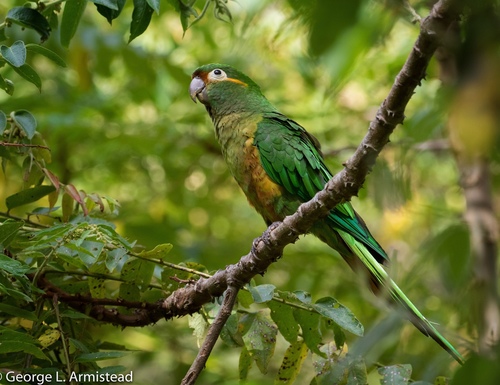
Golden-plumed Parakeet
Leptosittaca branickii
A rare high-altitude treasure of the Andes, the Golden-plumed Parakeet is a master of the misty cloud forest. Distinguished by its brilliant orange-yellow eye plumes and unique UV vision, this social bird is a true icon of South American highland biodiversity.
Quick Identification
Size
34–36 cm (13.5–14 inches) in length; approximately 150g (5.3 oz) in weight
Colors
Primary green body with a distinctive golden-yellow plume extending from the eye; dull orange patches on the belly and under-wing coverts
Key Features
- Long golden-yellow streak from eye to ear coverts
- Orange-red patch on the center of the abdomen
- Heavy, horn-colored bill
- Long, pointed green tail
When You’ll See Them
Geographic range
Where Does the Golden-plumed Parakeet Live?
Native to the rugged heights of South America, the Golden-plumed Parakeet is found exclusively along the temperate eastern slopes of the Andes. Its range extends through the highland corridors of Colombia, Ecuador, and Peru, where it relies on undisturbed old-growth forests. Because it is a high-altitude specialist, its distribution is naturally fragmented, occurring only in specific mountain pockets where its preferred food sources and nesting trees remain intact.
Basemap © OpenStreetMap contributors
Behavior
Golden-plumed Parakeets are highly social birds, typically encountered in noisy, energetic flocks of 5 to 20 individuals. They are high-altitude specialists, spending much of their time navigating the misty canopies of Andean cloud forests. Unlike many other parakeets that prefer open lowlands, this species is uniquely adapted to the thin air and temperate climates of the mountains, where they can be seen performing acrobatic flights through the trees.
These birds are known for their nomadic tendencies, following the seasonal fruiting cycles of highland trees. While they are generally shy and difficult to approach on foot, their loud, screeching calls often give them away long before they are seen. In flight, they move with a swift, direct wingbeat, often flashing the orange undersides of their wings which serves as a brilliant contrast to their primary green plumage.
EverydayEarth exclusive
Camera Tips
Capturing the Golden-plumed Parakeet on camera requires a specialized approach due to their high-altitude, canopy-dwelling nature. If you are located in an area where they are known to forage, the best placement for a camera is overlooking a stand of fruiting Podocarpus or Sapium trees. These birds rarely descend to the ground, so mounting your camera on a high ridge or using a tree-climbing kit to place it at canopy level (15-20 feet) will significantly increase your chances of a clear shot.
Because these parakeets are incredibly fast and travel in tight-knit groups, you should set your camera to a high-speed 'Burst Mode' or high-definition video. A single photo often misses the bird as it darts through the foliage; a burst of 5-10 frames ensures you capture the exact moment their golden plumes are visible. If using video, ensure your trigger speed is set to the fastest possible setting (0.2 seconds or less) to catch them as they land.
While they don't frequent traditional backyard bird feeders, they are highly attracted to water sources in the dry season. Setting up a high-elevation bird bath or a slow-dripping water feature on a balcony or platform can lure them in. Interestingly, as the only parakeet known to detect ultraviolet radiation, they are particularly sensitive to lighting conditions. Cameras positioned to catch the soft 'golden hour' light of early morning will best highlight the vibrant, reflective quality of their feathers that is invisible to the human eye in lower light.
Similar Species
Species that look similar or are commonly confused with Golden-plumed Parakeet.
Frequently Asked Questions
Record Golden-plumed Parakeet at your habitat
Connect a camera to start building your own species record — AI identifies every visitor automatically.