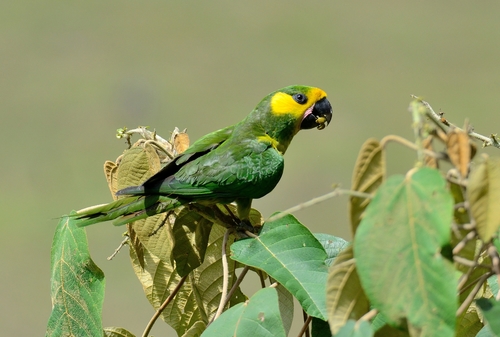
Yellow-eared Parrot
Ognorhynchus icterotis
Once thought extinct, the Yellow-eared Parrot is a vibrant symbol of Colombian conservation. These brilliant green and gold birds live in a spectacular, high-altitude partnership with the world's tallest palm trees.
Quick Identification
Size
Length of 42–46 cm (16.5–18 in); Weight approximately 250–350 g (8.8–12.3 oz)
Colors
Bright green body with large, distinctive yellow patches on the forehead, face, and 'ears'. Underparts are a lighter, yellowish-green.
Key Features
- Striking yellow facial patches extending behind the eyes
- Heavy, dark grey hooked beak
- Long, pointed green tail
- Large size compared to most montane parakeets
When You’ll See Them
Geographic range
Where Does the Yellow-eared Parrot Live?
Native to the South American continent, the Yellow-eared Parrot is found exclusively in the high-altitude Andean regions of Colombia. Its current range is restricted to the Central and Western Cordilleras, with core populations concentrated in departments like Quindío and Tolima. While it was historically reported in northern Ecuador, it is currently considered a Colombian endemic with no known introduced populations outside this narrow mountain corridor.
Basemap © OpenStreetMap contributors
Behavior
Historically, they were wary of humans due to hunting and habitat destruction, but conservation efforts have fostered a closer relationship with local communities. They are now seen as a symbol of pride in their native regions, though they remain cautious and easily startled by sudden movements or loud noises near their nesting sites. During the breeding season, they become fiercely protective of the palm cavities they call home.
EverydayEarth exclusive
Camera Tips
Capturing the Yellow-eared Parrot on a trail camera requires a strategic approach focused on their vertical habitat. Because these birds spend the majority of their time in the canopy, ground-level cameras are unlikely to find success. Instead, mount your AI-powered camera high on a hillside that overlooks a stand of Wax Palms. If you are working on a private reserve or property with these palms, use a professional-grade tree mount to position the camera 15-20 feet up, facing a known nesting cavity or a cluster of ripening palm fruit.
The lighting in Andean cloud forests is notoriously tricky, with heavy mist and high-contrast sunlight. Set your camera to a high shutter speed to freeze the motion of their fast wingbeats, and ensure your AI model is calibrated to recognize birds in flight. Because these parrots travel in noisy flocks, you can use an external microphone if your camera supports it; the sound of their distinctive squawking can serve as an early warning for the camera to wake from sleep mode.
Since these birds are dietary specialists, traditional birdseed lures will not work. Your best 'bait' is the presence of the Quindío Wax Palm itself. Focus your camera on the fruit-bearing fronds during the peak fruiting months. To protect your equipment from the high-altitude humidity and frequent rain, use a waterproof housing and include silica gel desiccant packs inside the battery compartment to prevent lens fogging during the rapid temperature shifts of the Andean morning.
Similar Species
Species that look similar or are commonly confused with Yellow-eared Parrot.
Frequently Asked Questions
Record Yellow-eared Parrot at your habitat
Connect a camera to start building your own species record — AI identifies every visitor automatically.