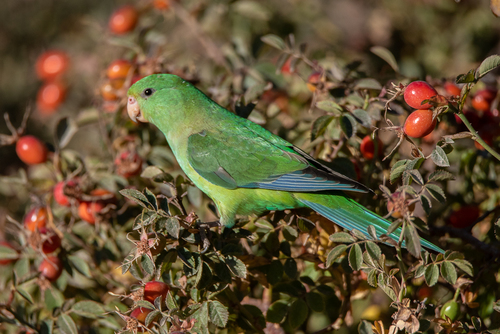
Mountain Parakeet
Psilopsiagon aurifrons
The Mountain Parakeet is a resilient and vibrant resident of the high Andes. With its brilliant green plumage and social personality, this small parrot brings life and noise to the rugged Puna grasslands.
Quick Identification
Size
17-20 cm (6.7-7.9 inches) in length; weight approximately 33-45 grams (1.1-1.6 oz)
Colors
Primary plumage is bright leaf-green. Adult males of the nominate subspecies have a vivid yellow forehead and face, while females are mostly green with reduced yellow or pale yellowish-white on the forehead.
Key Features
- Bright green body with a long, pointed tail
- Striking yellow face and forehead in males
- Pale, horn-colored bill
- Loud, metallic chattering calls given in flight
When You’ll See Them
Geographic range
Where Does the Mountain Parakeet Live?
The Mountain Parakeet is native to the rugged Andes Mountains of South America. Its core range extends from the highlands of central Peru through Bolivia and into northern Chile and northwestern Argentina. While they are considered non-migratory, they are known to perform altitudinal migrations, moving to lower, warmer valleys during the harsh winter months to seek better food supplies.
Basemap © OpenStreetMap contributors
Behavior
While they are naturally wary in the wild, these parakeets have become increasingly common in high-altitude human settlements. They establish communal roosts in cliffs or tall trees and follow a strict daily routine, leaving their roosts shortly after sunrise to find food and water. Within their groups, they exhibit complex social interactions, including allopreening (mutual grooming) between mated pairs.
EverydayEarth exclusive
Camera Tips
To capture the Mountain Parakeet on your backyard or trail camera, focus on water and height. In the arid high-altitude environments they inhabit, water is a powerful magnet. If you have a birdbath or a small water feature, place your camera nearby at a height of 3-5 feet. These birds prefer to land on a nearby branch first to scan for predators, so position the camera to include both the water and a nearby 'staging' perch. Use a fast trigger speed (0.3s or less) because these parakeets are lightning-fast and rarely sit still for long.
If you are using a feeder to attract them, offer small seeds like millet, canary seed, or sunflower hearts. Mountain Parakeets are flock-oriented; if one lands, ten more usually follow. To get the best shots, use a wide-angle setting on your camera rather than a tight zoom. This ensures you capture the social dynamics of the entire flock rather than just one bird. Set the camera to 'Photo + Video' mode if possible, as their rapid, chattering vocalizations are just as interesting as their vibrant green plumage.
Lighting is crucial in the bright Andean sun. Avoid pointing your camera directly into the sun to prevent silhouette effects. Instead, face the camera north or south so the birds are side-lit or front-lit during their peak morning activity. In the winter months, when food is scarce, they are much more likely to visit backyard stations at lower elevations, making this the best time for high-quality close-ups. Look for areas with dense shrubbery nearby, as they feel safest when they have a quick escape route into the bushes.
Similar Species
Species that look similar or are commonly confused with Mountain Parakeet.
Frequently Asked Questions
Record Mountain Parakeet at your habitat
Connect a camera to start building your own species record — AI identifies every visitor automatically.