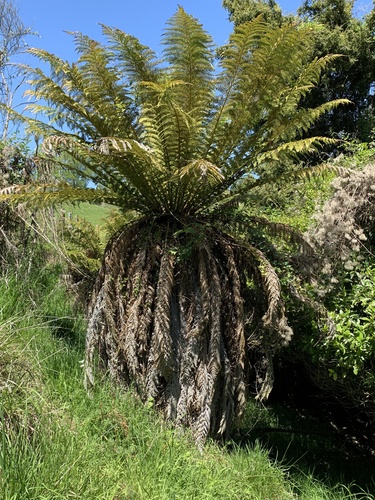
golden tree fern
Dicksonia fibrosa
The golden tree fern is a stoic, slow-growing pillar of the New Zealand bush, famous for its thick fibrous trunk and distinctive 'skirt' of dead fronds. A favorite for backyard naturalists, it creates a lush, prehistoric atmosphere while providing a vital home for local wildlife.
Quick Identification
Size
Grows up to 6 meters (20 feet) tall; fronds reach 1-2 meters (3.3-6.6 feet) long; trunk diameter up to 60 centimeters (24 inches).
Colors
Lush deep green fronds; trunk is a rich golden-brown or russet color due to dense fibrous roots; dead fronds turn a pale chocolate brown.
Key Features
- Thick, columnar trunk made of matted fibrous roots
- Persistent 'skirt' of dead brown fronds hanging from the crown
- Slow-growing habit, often only a few centimeters per year
- Stiff, leathery fronds that are shorter and more compact than other species
When You’ll See Them
Behavior
While the golden tree fern doesn't move in the traditional sense, it plays a dynamic role in the backyard ecosystem. It is a slow-growing giant, often taking decades to reach its full height. Unlike many other tree ferns that drop their dead fronds, the golden tree fern retains them, creating a thick, insulating 'skirt' around the trunk. This skirt isn't just for show; it protects the trunk from drying out and provides a complex microhabitat for a variety of insects and small invertebrates.
In a garden or forest setting, the golden tree fern acts as a host. Its fibrous trunk is excellent at holding moisture, which allows mosses, liverworts, and even small epiphytic ferns to take root directly on its surface. For the homeowner, it is a sturdy and reliable presence that provides year-round structure and shade for smaller, more delicate plants beneath its canopy.
EverydayEarth exclusive
Camera Tips
Capturing the golden tree fern on a trail camera is less about catching 'action' and more about documenting the life of a micro-ecosystem. To get the best results, mount your camera on a nearby post or tree at mid-trunk height, roughly 3 to 4 feet off the ground. Angle the lens slightly upward to capture both the texture of the fibrous trunk and the underside of the emerging fronds. This perspective allows you to see the skinks and insects that frequent the trunk's crevices.
If your camera has a time-lapse mode, the golden tree fern is a perfect subject. Set the camera to take one photo every hour during the spring months (September to November in the Southern Hemisphere). When played back, you’ll see the 'koru' or croziers unfurl in a beautiful, coiled dance—a process that is normally too slow for the human eye to appreciate. Ensure your camera is set to a high resolution to capture the fine, golden hairs on the new growth.
Because these ferns thrive in damp, dim conditions, lighting can be a challenge. If possible, position the camera so it faces away from the direct morning sun to avoid lens flare, but try to catch the dappled afternoon light as it filters through the canopy. This 'golden hour' light will make the russet colors of the trunk pop. If your camera has an adjustable PIR (motion) sensor, set it to high sensitivity if you are hoping to catch the small birds, like fantails, that often flit around the crown to hunt the insects living in the skirt.
Lastly, keep the lens clean! The humid environment the golden tree fern loves is also prone to condensation and algae growth on camera housing. Check your gear every few weeks to wipe the lens with a microfiber cloth and ensure your battery levels are high, as the cooler, shaded spots can cause batteries to drain slightly faster than in full sun.
Similar Species
Species that look similar or are commonly confused with golden tree fern.
Frequently Asked Questions
Record golden tree fern at your habitat
Connect a camera to start building your own species record — AI identifies every visitor automatically.