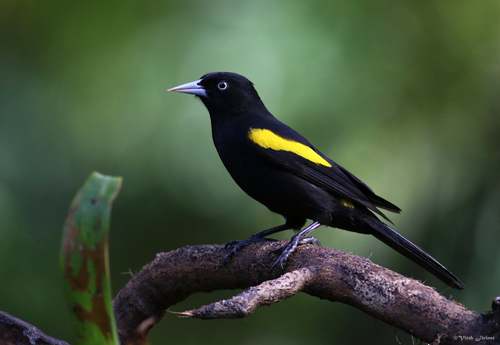
Golden-winged Cacique
Cacicus chrysopterus
Adorned with brilliant golden epaulets and ivory-colored bills, the Golden-winged Cacique is a master of mimicry and motion. This striking South American songbird brings a flash of tropical color to forest edges and backyard feeders alike.
Quick Identification
Size
Approximately 19-20 cm (7.5-8 inches) in length; weighs between 30-45 grams (1.1-1.6 oz).
Colors
Glossy black body with vibrant golden-yellow shoulder patches (epaulets) and a bright yellow rump. Features a pale ivory bill and striking white or light blue eyes.
Key Features
- Vibrant golden-yellow wing coverts
- Striking pale blue or white iris
- Slender, pointed pale ivory bill
- Glossy jet-black plumage
- Yellow rump visible in flight
When You’ll See Them
Geographic range
Where Does the Golden-winged Cacique Live?
Where Does the Golden-winged Cacique Live? This species is a classic inhabitant of the Southern Cone of South America. Its native range spans the lush Atlantic Forest regions of southern Brazil, extending westward into the lowlands of eastern Bolivia and across the border into southeastern Paraguay. It is also a common sight in the northern reaches of Argentina and throughout Uruguay, where it thrives in both dense woodland and wooded suburban fringes.
Basemap © OpenStreetMap contributors
Behavior
The Golden-winged Cacique is a high-energy, intelligent member of the Icteridae family. Unlike some of its noisier, colony-dwelling relatives, this species is often found in pairs or small, discreet family groups. They are exceptionally agile foragers, frequently seen hanging upside down from thin branches or probing deeply into epiphytes and bromeliads in search of hidden prey. Their flight is direct and swift, punctuated by the flash of their yellow rumps.
One of their most fascinating traits is their vocal ability. Golden-winged Caciques are gifted mimics, weaving the calls of other bird species—and even mechanical sounds—into their own complex, liquid songs. While they are primarily forest-dwellers, they are adaptable and will venture into rural gardens and orchards, especially when fruit is ripening. They are less aggressive than larger caciques but remain highly territorial during the nesting season.
EverydayEarth exclusive
Camera Tips
To capture the stunning contrast of the Golden-winged Cacique, place your camera near 'soft' forest edges or where your garden meets dense shrubbery. These birds prefer mid-level canopy but will descend to eye level for high-energy food sources. Position your camera about 1.5 to 2 metres (5-7 feet) high, ideally pointing toward a sturdy horizontal branch or a hanging fruit feeder. Because of their glossy black feathers, avoid direct, harsh midday sun which can blow out the highlights; morning or late afternoon light will best capture the iridescence of their plumage.
Attracting them to your lens is easiest with fruit lures. They are particularly fond of halved oranges, papayas, and overripe bananas secured to a platform or spiked on a branch. If you have flowering native trees like Erythrina, aim your camera there, as they are frequent nectar drinkers. Using a camera with a fast trigger speed is essential, as these birds are constant movers and rarely stay still for long.
For the best AI recognition, ensure the camera has a clear view of the bird's head and wing. The pale eye and yellow 'shoulder' are the primary markers for most identification algorithms. If your camera settings allow, use a high-frame-rate video mode or a 3-shot burst to catch the moment they flare their wings, revealing the brilliant yellow rump that is often hidden while perched.
Similar Species
Species that look similar or are commonly confused with Golden-winged Cacique.
Frequently Asked Questions
Record Golden-winged Cacique at your habitat
Connect a camera to start building your own species record — AI identifies every visitor automatically.