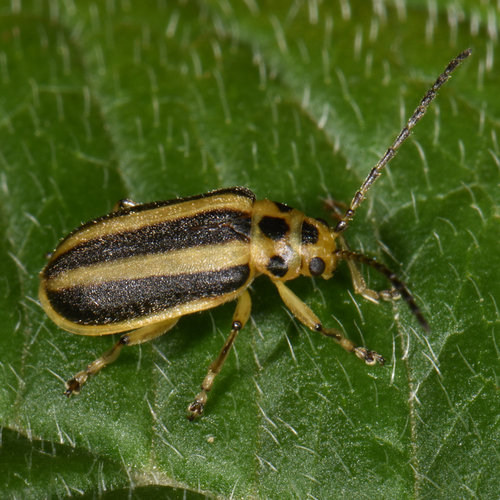
Goldenrod Leaf Beetle
Trirhabda canadensis
A striking striped specialist of the summer meadow, the Goldenrod Leaf Beetle is a master of its botanical niche. Often found in busy clusters, these beetles are a sign of a healthy, biodiverse backyard ecosystem.
Quick Identification
Size
7 to 12 mm (0.28 to 0.47 inches) in length
Colors
Dull yellow to light tan base color with three distinct black longitudinal stripes on the wing covers. The head features a prominent black spot on the vertex.
Key Features
- Three dark parallel stripes running down the elytra (wing covers)
- Large black spot on the center of the pronotum
- Robust, elongated oval body shape
- Commonly found in large groups on goldenrod plants
When You’ll See Them
Behavior
The Goldenrod Leaf Beetle is a specialized herbivore that spends its entire life cycle in close proximity to goldenrod plants. During the summer months, adults can be found in significant numbers, often congregating on the same leaf to feed and mate. They are relatively docile and slow-moving, relying more on their camouflage and the density of the meadow foliage for protection than on quick flight.
These beetles are known for their 'skeletonizing' feeding pattern, where they consume the soft tissue of the goldenrod leaves while leaving the veins intact. While this can make a goldenrod patch look a bit tattered, it is a natural part of the meadow ecosystem. In the late summer, the females lay eggs in the soil near the base of the plants, where the next generation will overwinter before emerging as larvae in the spring.
EverydayEarth exclusive
Camera Tips
Capturing the Goldenrod Leaf Beetle on camera requires a dedicated macro setup or a trail camera with a very close focal range. Because these beetles are small and tend to stay stationary while feeding, you should mount your camera on a stable stake or a flexible tripod directly within a patch of goldenrod. Aim the lens at the upper foliage, specifically the underside of leaves or the tender growth near the top of the stem, as this is where the beetles most frequently congregate to avoid the direct midday sun.
Since these insects move slowly, they may not always trigger a standard PIR (Passive Infrared) sensor. To get the best results, use a time-lapse setting that takes a photo every 60 seconds during peak daylight hours. This will allow you to see the beetles slowly 'grazing' across the leaf surface over time. If your camera has a high-sensitivity motion trigger, ensure it is positioned within 12 inches of the plant to catch the subtle movements of the beetles as they reposition themselves or engage in mating behavior.
Lighting is a critical factor when filming these beetles. The bright yellow and tan of their bodies can easily wash out in direct, harsh sunlight. Try to position your camera so the host plant is back-lit or side-lit during the golden hour, which will emphasize the texture of their striped wing covers. If you are using a camera with a flash for evening shots, use a diffuser to avoid a harsh glare off their somewhat shiny exoskeletons. Early July is the absolute best time for recording, as population densities are at their highest and the beetles are at their most active.
Similar Species
Species that look similar or are commonly confused with Goldenrod Leaf Beetle.
Frequently Asked Questions
Record Goldenrod Leaf Beetle at your habitat
Connect a camera to start building your own species record — AI identifies every visitor automatically.