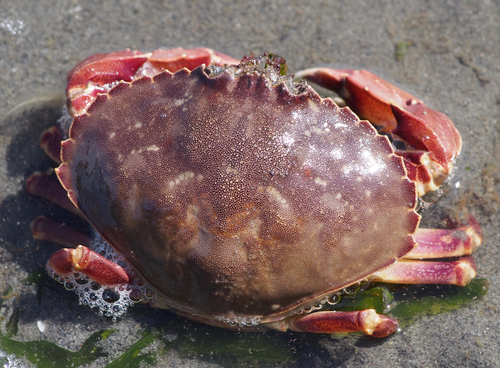
Graceful Rock Crab
Metacarcinus gracilis
Elegant and agile, the Graceful Rock Crab is a common but often overlooked resident of Pacific bays. Known for its distinctive white-tipped claws and its unique habit of hitchhiking on jellyfish as a juvenile, this crab is a fascinating subject for underwater discovery.
Quick Identification
Size
Carapace width up to 11 cm (4.3 in); total leg span up to 20 cm (8 in)
Colors
Carapace is typically tan, olive-brown, or grayish-purple; claws are notably tipped with white
Key Features
- Distinctive white-tipped claws (chelae)
- Slender, long walking legs relative to body size
- Smooth, oval-shaped carapace with 10 small teeth on each side
When You’ll See Them
Geographic range
Where Does the Graceful Rock Crab Live?
The Graceful Rock Crab is a native of the Eastern Pacific coastline of North America. Its distribution stretches from the cold waters of Alaska through the coastal regions of British Columbia, Washington, Oregon, and California. The southern limit of its core range reaches the warm-temperate waters of Bahía Magdalena in Baja California Sur, Mexico.
Basemap © OpenStreetMap contributors
Behavior
The Graceful Rock Crab is aptly named for its agile and nimble movement compared to its heavier-bodied relatives. Unlike the stockier Red Rock Crab, this species moves with speed across sandy and muddy substrates. They are primarily solitary scavengers, though they can be found in high densities where food sources like fish carcasses or crushed mollusks are abundant. One of their most remarkable behaviors is their symbiotic relationship during their juvenile stage: young crabs are frequently observed 'riding' the bells of large jellyfish, such as the Egg-yolk Jelly. This behavior provides the young crabs with protection from predators and easy access to food particles caught in the jellyfish's tentacles.
As adults, they are highly sensitive to tidal movements and often migrate from deeper water into shallow bays and estuaries to forage. They are not particularly aggressive toward humans but are extremely quick to bury themselves in the sand or vanish into eelgrass beds if they feel vibration or see a shadow. While they are occasionally caught in crab pots meant for larger species, they are generally too small to be a primary target for commercial fishing, allowing them to remain quite common in many Pacific coastal areas.
EverydayEarth exclusive
Camera Tips
To capture high-quality footage of a Graceful Rock Crab, you must use an underwater camera system or a waterproof action camera. Because these crabs prefer soft, silty bottoms, the best placement is on the seafloor near a structure like a pier piling or at the edge of an eelgrass bed. Use a weighted base or a 'sand-screw' mount to keep the camera steady against tidal currents. Position the lens about 6 inches off the bottom, angled slightly downward to capture the crab's movement and the diagnostic white tips of its claws.
Bait is the most effective way to draw these crabs into the camera's field of view. Use a small, perforated bait box or mesh bag filled with oily fish, such as sardines or herring. Secure the bait exactly 18 to 24 inches from the lens to ensure the crab remains in focus while it feeds. If you are filming in a backyard bay or marina, suspending the camera from a dock using a stable pole mount can provide a 'top-down' view that is excellent for observing their scurrying behavior across the mud.
Lighting is crucial for underwater captures. If filming at night or in murky estuary water, use an external wide-angle underwater video light. To avoid 'backscatter' (light reflecting off particles in the water), position the light source slightly to the side of the camera rather than directly next to the lens. Because these crabs are active throughout the day, natural light is often sufficient in shallow water (under 10 feet), but early morning and late afternoon provide the most dramatic, high-contrast shots as the crabs emerge from hiding.
Similar Species
Species that look similar or are commonly confused with Graceful Rock Crab.
Frequently Asked Questions
Record Graceful Rock Crab at your habitat
Connect a camera to start building your own species record — AI identifies every visitor automatically.