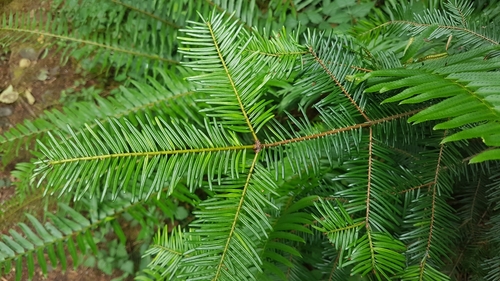
grand fir
Abies grandis
A towering titan of the Pacific Northwest, the grand fir is famous for its citrus-scented needles and its role as a luxury high-rise for forest wildlife.
Quick Identification
Size
Height ranges from 30–80 meters (100–260 feet) with a trunk diameter up to 2 meters (6.5 feet).
Colors
Glossy dark green needles with two bright white stripes on the underside; bark is smooth and greyish with resin blisters when young, turning brown and furrowed with age.
Key Features
- Flat, needle-like leaves arranged in two distinct rows
- Strong citrus-like fragrance when needles are crushed
- Large, cylindrical cones that grow upright on top branches
- Bark features prominent sap blisters on younger specimens
When You’ll See Them
Behavior
The grand fir is a stately, fast-growing conifer known for its incredible shade tolerance and massive stature. In a backyard or forest setting, it acts as a foundational 'high-rise' for local wildlife. While it doesn't move, its growth cycle is a hive of activity, providing critical nesting sites for raptors and songbirds in its dense upper canopy, while the lower branches offer thermal cover for mammals during harsh winters.
Ecologically, the grand fir is a generous neighbor. It often grows alongside Douglas firs and western red cedars, creating a multi-layered canopy. Its needles are a primary food source for blue grouse, and its seeds are coveted by squirrels and nuthatches. For humans, it is one of the most fragrant trees in the Pacific Northwest, often used as a Christmas tree because of its symmetry and pleasant scent.
EverydayEarth exclusive
Camera Tips
When setting up a trail camera to capture the ecosystem surrounding a grand fir, focus on the 'hub' factor. Because grand firs have thick, flat branches, they are preferred runways for squirrels and chipmunks. Mount your camera about 5–8 feet up a neighboring tree, angled toward a sturdy horizontal limb of the grand fir. Use a high-sensitivity motion trigger to catch quick-moving mammals or birds like the varied thrush that forage among the needles.
For those interested in the grand fir's role as a shelter, place your camera at the base of the trunk facing outward. Many ground-dwelling species, such as rabbits or deer, will use the low-hanging 'skirt' of a grand fir as a windbreak. To capture these interactions, ensure your camera has a wide-angle lens and set it to 'Hybrid' mode—taking a high-resolution photo followed by a 10-second video—to see how animals utilize the tree's protection.
Lighting can be a challenge under the dense canopy of a grand fir. To avoid 'white-out' photos from the flash, position the camera so it isn't facing directly into the darkest recesses of the branches. Instead, aim for the edge of the drip line where natural light filters through. If you are tracking the tree's growth or seasonal changes, use a time-lapse setting, taking one photo every 24 hours at noon to see the incredible transformation from spring bud-burst to winter snow-loading.
Similar Species
Species that look similar or are commonly confused with grand fir.
Douglas Fir
Douglas fir needles encircle the entire twig like a bottle brush, whereas grand fir needles are flat and parted like hair.
Pacific Silver Fir
Silver fir needles point forward and upward, covering the twig, while grand fir needles lay out flat in two rows.
Western Hemlock
Hemlocks have much shorter needles of varying lengths and a distinctively drooping 'leader' or top-most branch.
Frequently Asked Questions
Record grand fir at your habitat
Connect a camera to start building your own species record — AI identifies every visitor automatically.