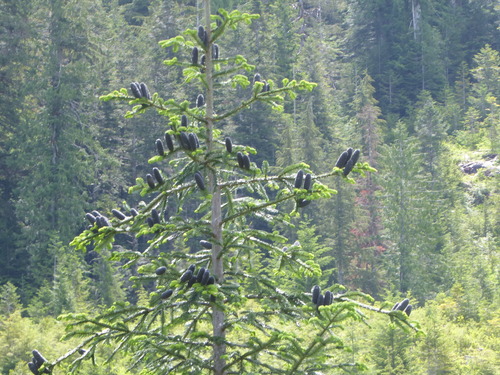
Pacific silver fir
Abies amabilis
The Pacific silver fir is the shimmering 'lovely' fir of the Northwest, easily identified by its snowy-bottomed needles and regal, upright purple cones. A cornerstone of the misty Cascade forests, it provides essential shelter and food for a vast array of mountain wildlife.
Quick Identification
Size
Typically grows 30–55 m (100–180 ft) tall with a trunk diameter of 60–120 cm (2–4 ft).
Colors
Dark, glossy green needles with two bright silvery-white bands underneath; smooth silvery-gray bark with resin blisters.
Key Features
- Flat needles arranged in a 'v' shape or pointing forward like a comb
- Two distinct silvery-white lines on the needle undersides
- Upright, barrel-shaped cones that are deep purple when young
- Smooth, ash-gray bark that develops plates with extreme age
When You’ll See Them
Behavior
The Pacific silver fir is a patient giant of the Pacific Northwest, renowned for its incredible shade tolerance. In the deep, dark understory of old-growth forests, young saplings can survive for decades in a state of suppressed growth, waiting for a larger tree to fall and create a gap in the canopy. Once the sunlight reaches them, they begin a steady climb toward the sky, eventually forming a narrow, spire-like crown that sheds heavy snow efficiently.
Ecologically, this tree acts as a vital 'apartment complex' for forest wildlife. Its dense foliage provides thermal cover for birds and small mammals during harsh winters, and its seeds are a significant food source for squirrels and crossbills. While it is a slow-growing species compared to the Douglas-fir, its longevity allows it to become a dominant force in climax forests, often living 500 years or more.
EverydayEarth exclusive
Camera Tips
When using a trail camera to capture the beauty of a Pacific silver fir, placement is everything. Because these trees often grow in dense, dark stands, lighting can be a challenge. Position your camera on a north-facing slope if possible, or at an angle where the morning or evening 'golden hour' light can filter through the canopy. This horizontal light is the best way to highlight the 'silver' in the needles, as the undersides will shimmer when caught in the breeze. Set your camera to a higher ISO or 'low light' mode to compensate for the deep forest shade.
To capture the wildlife that frequents this species, mount your camera about 3–5 feet up a neighboring tree, facing a lower branch of the fir. These branches are popular 'highways' for Douglas squirrels and northern flying squirrels. If you are in a snowy climate, place a camera near the base of the trunk during winter. The dense canopy creates 'snow wells'—areas of shallower snow near the trunk—which become hotspots for deer, elk, and varied thrushes looking for a reprieve from the deep powder.
If you have an AI-powered camera with time-lapse capabilities, the Pacific silver fir is a perfect subject for a long-term project. Set the camera to take one photo daily at noon. Over a year, you will see the fascinating way the branches bow under feet of snow and spring back in May, and you'll witness the upright, purple cones disintegrating scale-by-scale to release their seeds, rather than falling to the ground whole like pine cones.
Keep in mind that the Pacific silver fir is famous for its resin blisters—small pockets of sticky sap on the bark. Avoid mounting your camera directly over one of these blisters, as the sap is difficult to remove from camera casings and can permanently smudge a lens if it drips. Using a stand-off mount or a tree strap that keeps the camera body slightly away from the bark surface is a wise precaution.
Similar Species
Species that look similar or are commonly confused with Pacific silver fir.
Grand Fir
Grand fir needles are arranged in two flat, horizontal rows, whereas Pacific silver fir needles point forward and cover the top of the twig.
Subalpine Fir
Subalpine fir needles have stomatal (white) lines on both the top and bottom, while Pacific silver fir only has them on the bottom.
Noble Fir
Noble fir needles are shaped like hockey sticks (curved at the base) and its cones have distinctive papery bracts that stick out.
Frequently Asked Questions
Record Pacific silver fir at your habitat
Connect a camera to start building your own species record — AI identifies every visitor automatically.