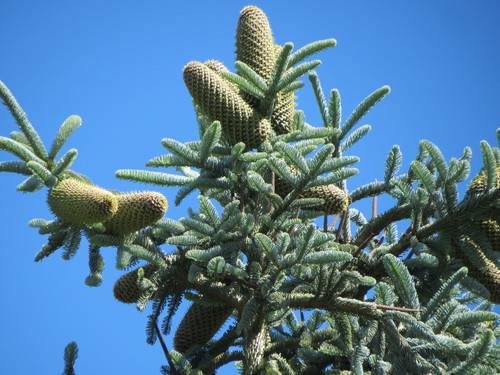
noble fir
Abies procera
The Noble Fir is a towering icon of the Pacific Northwest mountains, known for its incredible symmetry and striking silver-blue foliage. As the largest of all true firs, it serves as a vital high-altitude sanctuary for a diverse range of forest wildlife.
Quick Identification
Size
40–70 meters (130–230 ft) tall, with a trunk diameter of up to 2 meters (6.5 ft)
Colors
Silvery blue-green needles, gray-brown smooth bark on young trees, reddish-brown furrowed bark on mature specimens
Key Features
- S-curved needles with a 'hockey stick' base
- Large, upright cylindrical cones with protruding, papery bracts
- Perfectly symmetrical, spire-like growth habit
- Two white stomatal bands on both the top and bottom of needles
When You’ll See Them
Behavior
The Noble Fir is the largest and most impressive species in the Abies genus, often referred to as the 'King of the Firs.' Unlike many other conifers that can look ragged in old age, the Noble Fir maintains a remarkably neat, symmetrical shape even as it reaches heights exceeding 200 feet. It is a long-lived species, often surviving for over 300 years in the high-elevation forests of the Pacific Northwest, where it stands as a stoic sentinel against heavy mountain snows.
Ecologically, this tree acts as a high-rise apartment complex for forest wildlife. Its stiff, strong branches provide excellent platforms for large birds of prey, while its dense canopy offers thermal cover for mammals during harsh winters. It is a 'climax' species in many forest types, meaning it represents a stable, mature stage of the ecosystem, though it requires significant sunlight to establish itself in the early stages of growth.
EverydayEarth exclusive
Camera Tips
When using a trail camera to capture the life around a Noble Fir, placement is everything. These trees are hotspots for 'vertical' wildlife activity. To capture the most action, don't just point your camera at the trunk. If you have a safe way to mount a camera 10-15 feet up, aim it toward a cluster of ripening cones in late summer. This is where you will see Douglas squirrels and Clark’s Nutcrackers working feverishly to extract the nutrient-dense seeds.
For those capturing the tree from the ground, use a wide-angle lens setting to appreciate its massive scale. A time-lapse mode is particularly effective for Noble Firs; by taking one photo every morning, you can document the 'heaving' of the branches under winter snow and the vibrant, lime-green 'candles' of new growth that emerge in late spring. This tree’s silver-blue foliage reflects light beautifully, so try to position your camera facing north or south to avoid direct lens flare while capturing the soft side-lighting of the sun.
Because Noble Firs often grow in windy, high-altitude ridges, ensure your camera mount is extra secure. The thick, corky bark of a mature Noble Fir provides a stable base, but using a tree-screw mount or heavy-duty strap is recommended to prevent the wind from vibrating the camera and triggering false motion alerts. If your AI camera is programmed to recognize movement, focus your 'activity zone' on the lower branches where birds like the Varied Thrush are likely to land and forage.
Similar Species
Species that look similar or are commonly confused with noble fir.
Pacific Silver Fir
Its needles are flat and arranged in a spray, lacking the Noble Fir's distinct 'hockey stick' curve at the base.
Douglas Fir
Douglas Fir cones hang downward and have three-pointed bracts, whereas Noble Fir cones stand strictly upright.
Subalpine Fir
Subalpine Fir has much smaller, darker purple cones and a more narrow, spire-like shape adapted for even harsher climates.
Frequently Asked Questions
Record noble fir at your habitat
Connect a camera to start building your own species record — AI identifies every visitor automatically.