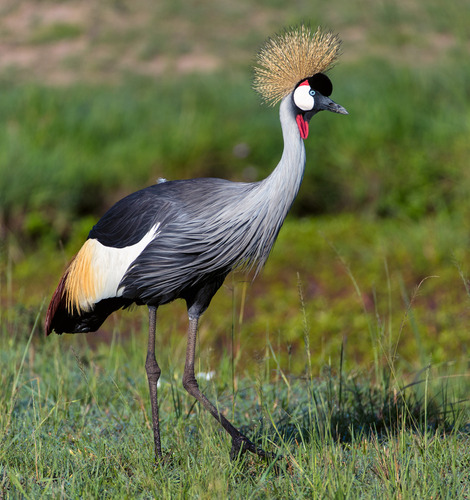
Gray Crowned-Crane
Balearica regulorum
Adorned with a halo of golden feathers and a striking red throat, the Gray Crowned-Crane is Africa's most elegant savanna dancer. As the national bird of Uganda, this endangered crane brings a touch of majesty to the wetlands and grasslands it calls home.
Quick Identification
Size
Length: 100–110 cm (39–43 in); Wingspan: 180–200 cm (71–79 in); Weight: 3–4 kg (6.6–8.8 lbs)
Colors
Slate-grey body plumage with black and white wings; distinct stiff golden crown; white cheeks with red spots; bright red throat pouch (gular sack); black forehead.
Key Features
- Stiff spray of golden feathers forming a crown
- Large white cheek patches with a red spot on the upper edge
- Bright red inflatable throat pouch
- Grey body with long black legs
When You’ll See Them
Geographic range
Where Does the Gray Crowned-Crane Live?
Native to the sweeping landscapes of Sub-Saharan Africa, the Gray Crowned-Crane is most commonly found across the eastern and southern regions of the continent. Its core range stretches from the marshes of Uganda and Kenya down through Tanzania, Zambia, and into the grassy plains of South Africa. While they are non-migratory, they may move locally to find water and food as seasons shift across the savanna.
Basemap © OpenStreetMap contributors
Behavior
Gray Crowned-Cranes are famous for their spectacular 'dances'—an elaborate display of jumping, bowing, and wing-spreading that helps maintain pair bonds and social order. Unlike many cranes, they have a unique ability to perch in trees thanks to a long hind toe, often roosting in high branches at night to avoid ground predators.
These birds are highly social during the non-breeding season, forming large flocks that forage together in wetlands or agricultural fields. However, during the breeding season, pairs become fiercely territorial. While they generally avoid direct human conflict, they have adapted to living near human settlements, often frequenting farmland where they forage for leftover grain or insects disturbed by livestock.
EverydayEarth exclusive
Camera Tips
To capture the majesty of the Gray Crowned-Crane, place your camera near known water sources or open fields where they perform their courtship dances. Because these birds are tall, mount your camera approximately 2 to 3 feet off the ground on a sturdy post or tree. Tilting the lens slightly upward will emphasize their height and make the golden crown pop against the sky or background vegetation.
Since they are most active in the early morning and late afternoon, ensure your camera's exposure settings are optimized for 'Golden Hour' lighting. High-speed shutter settings or a fast trigger speed (0.2s or less) are essential if you hope to catch a clear shot of them jumping or flapping their wings during a dance. If your camera supports video, use a 30-second clip duration to record their unique honking calls and synchronized movements.
If you are setting up in a farm or large estate setting, these cranes are often attracted to open, mowed areas where they can easily spot insects. Avoid placing cameras too close to their nesting sites in deep marshes, as they are sensitive to disturbance; instead, focus on the 'landing zones' or edges where the wetland meets the field. During dry spells, a reliable water source is the best way to ensure consistent sightings.
Similar Species
Species that look similar or are commonly confused with Gray Crowned-Crane.
Frequently Asked Questions
Record Gray Crowned-Crane at your habitat
Connect a camera to start building your own species record — AI identifies every visitor automatically.