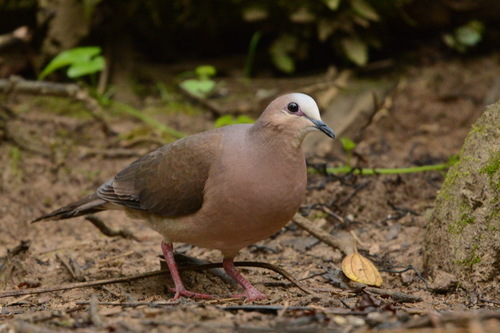
Gray-fronted Dove
Leptotila rufaxilla
A quiet dweller of the South American understory, the Gray-fronted Dove charms observers with its soft pastel plumage and haunting, rhythmic calls. Often found hidden in the shadows of the forest edge, this elegant ground-feeder is a prize find for any backyard camera enthusiast.
Quick Identification
Size
26-30 cm (10-12 inches) in length; weighs approximately 150-185g (5.3-6.5 oz)
Colors
Olive-brown upperparts, vinaceous-pink breast fading to a white belly, gray forehead and crown, with distinctive rufous-chestnut underwings.
Key Features
- Soft gray forehead and blue-gray crown
- Rufous-chestnut underwing coverts visible in flight
- Reddish-pink legs and feet
- Deep, hollow 'who-whooo' call
When You’ll See Them
Geographic range
Where Does the Gray-fronted Dove Live?
The Gray-fronted Dove is native to South America and the Caribbean island of Trinidad. Its core range encompasses the vast tropical lowlands of the Amazon Basin and the Atlantic Forest, stretching through Brazil, Colombia, Venezuela, and the Guianas, and extending southward into Bolivia, Paraguay, northern Argentina, and Uruguay. It is a permanent resident throughout its range, showing a strong preference for humid, wooded environments rather than open scrubland.
Basemap © OpenStreetMap contributors
Behavior
The Gray-fronted Dove is a somewhat secretive and terrestrial bird, spending much of its time walking quietly on the forest floor in search of food. Unlike some of its more gregarious cousins, this species is typically encountered alone or in pairs, rarely forming large flocks. It moves with a characteristic bobbing of the head, a common trait among doves, as it navigates through leaf litter and low vegetation.
While they are shy and often retreat into thick cover when approached, they are well-known for their low-pitched, mournful vocalizations that carry through the humid air of the forest understory. In areas where they are not hunted, they can become somewhat accustomed to human presence, occasionally visiting quiet garden edges or plantations, though they always remain vigilant and ready to take flight with a characteristic whirring of wings if startled.
EverydayEarth exclusive
Camera Tips
To capture the Gray-fronted Dove on a backyard or trail camera, ground-level placement is essential. Because these doves are terrestrial foragers, setting your camera just 15-30 centimeters (6-12 inches) off the ground will provide an intimate, eye-level perspective that highlights their delicate facial markings and iridescent neck feathers. Focus your efforts on the edges of wooded areas or beneath dense shrubbery where they feel secure from aerial predators.
Water is the single best lure for this species. A low-profile bird bath or a small ground-level pond in a quiet corner of your property will frequently attract Gray-fronted Doves, especially during the drier parts of the year. They prefer to drink in areas with nearby cover where they can retreat quickly. Position your camera to face the water source, but ensure it is angled to avoid direct glare from the sun, as the soft grays and pinks of their plumage can easily become 'washed out' in harsh lighting.
Since these birds often forage in the shade of the forest understory, use a camera with high-quality low-light performance. If your device allows for adjustable trigger speeds, set it to the fastest possible setting; while they walk slowly, their flight response is explosive, and you don’t want to miss the shot. Avoid using loud mechanical shutters if possible, as the 'click' may startle them before you get a series of natural-looking photos.
For baiting, a scattering of cracked corn, millet, or local birdseed mixes on the ground can be effective, but be patient. Gray-fronted Doves are more cautious than common pigeons and may take several days to regularly visit a new feeding spot. Check your camera during the early morning hours, as this is when their activity peaks and the 'golden hour' light beautifully saturates the vinaceous tones of their breast.
Similar Species
Species that look similar or are commonly confused with Gray-fronted Dove.
Frequently Asked Questions
Record Gray-fronted Dove at your habitat
Connect a camera to start building your own species record — AI identifies every visitor automatically.