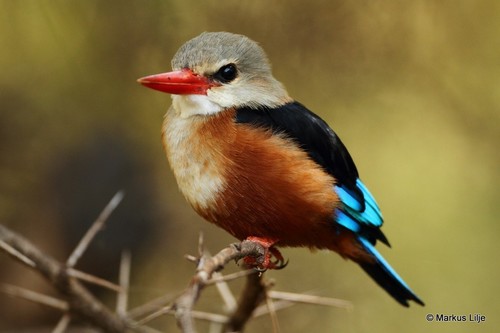
Gray-headed Kingfisher
Halcyon leucocephala
A stunning combination of silvery-grey and brilliant cobalt, the Gray-headed Kingfisher is a master of the African savanna. This patient hunter is a common garden visitor, trading the riverbank for a perfect backyard perch.
Quick Identification
Size
20–22 cm (7.9–8.7 in) in length; wingspan of 30–35 cm (12–14 in); weight between 35–60 g (1.2–2.1 oz)
Colors
Silvery-grey head and neck; black mantle and back; brilliant cobalt-blue rump, wings, and tail; rich chestnut-brown belly; bright red bill
Key Features
- Pale silvery-grey head and breast
- Rich chestnut-colored belly
- Bright red, dagger-like bill
- Brilliant blue wings and tail visible in flight
When You’ll See Them
Sightings on EverydayEarth
Jun 23, 2026
A Grey-headed Kingfisher is perched alertly on the end of a bleached, fallen log over the moving water. It scans the surroundings, occasionally twitching its head as it searches for prey.
Geographic range
Where Does the Gray-headed Kingfisher Live?
The Gray-headed Kingfisher is a widespread native of the African continent and parts of the southern Arabian Peninsula. Its core range spans from the semi-arid belts of Senegal and Mauritania in the west, across to the highlands of Ethiopia and Somalia, and southward through East Africa into South Africa. While they are common across the mainland, they are also established on islands such as the Cape Verde archipelago and Zanzibar, following seasonal rains in complex intra-African migration patterns.
Basemap © OpenStreetMap contributors
Behavior
The Gray-headed Kingfisher is a fascinating 'woodland' kingfisher that, despite its name, is frequently found far from open water. It is a classic sit-and-wait predator, often seen perched motionless on a low-hanging branch or fence post. From this vantage point, it scans the ground for movement, diving down with precision to snatch up insects or small vertebrates before returning to the same perch to consume its meal.
These birds are generally solitary or found in pairs and are known for their relatively quiet demeanor compared to the noisy Woodland Kingfisher. During the breeding season, they become more territorial and vocal, using a series of high-pitched piping notes. They are hole-nesters, excavating tunnels into vertical sandy banks, often near gullies or road cuttings, where they lay their clutches of white eggs away from the eyes of predators.
EverydayEarth exclusive
Camera Tips
To successfully capture the Gray-headed Kingfisher on a backyard or trail camera, focus on their hunting habits rather than water sources. These birds are 'perch hunters.' Identify a horizontal branch or a fence rail that sits about 1.5 to 3 meters (5-10 feet) above an area of short grass or bare soil. This is where the bird will spend hours watching for insects. Mount your camera on a nearby tree or post at roughly the same height as the perch, or slightly higher, angled at 45 degrees to cover both the perch and the ground below.
Timing and light are crucial for capturing their vivid colors. Because their wings are a brilliant cobalt blue and their bellies a deep chestnut, you want to avoid the harsh midday sun which can 'blow out' the highlights. North-facing setups are ideal to ensure soft, consistent lighting throughout the morning and late afternoon when the birds are most active. Use a fast trigger speed setting—ideally under 0.5 seconds—as these birds move with explosive speed once they spot prey.
If you want to encourage them to visit a specific spot, avoid traditional seed feeders, as they are strictly carnivorous. Instead, focus on creating a hospitable environment for their prey. A pesticide-free lawn will attract the grasshoppers and crickets they love. You can also place a 'perching stake' near a birdbath; while they may not swim, they will often visit water to bathe or drink, especially in drier climates. Set your camera to 'Burst Mode' or a short 10-second video clip to catch the characteristic head-bobbing behavior they exhibit before diving.
Similar Species
Species that look similar or are commonly confused with Gray-headed Kingfisher.
Brown-hooded Kingfisher
Lacks the rich chestnut belly of the Gray-headed and has a more streaked, brownish head pattern.
Woodland Kingfisher
Has a much more vibrant blue head and breast and lacks the chestnut belly entirely.
Mangrove Kingfisher
Larger, with a much heavier bill and a grayer, less silvery head, typically restricted to coastal habitats.
Frequently Asked Questions
Record Gray-headed Kingfisher at your habitat
Connect a camera to start building your own species record — AI identifies every visitor automatically.