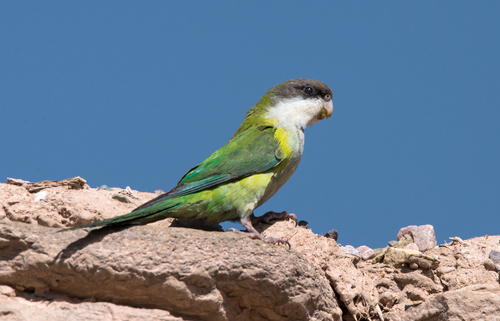
Gray-hooded Parakeet
Psilopsiagon aymara
A charming emerald gem of the Andes, the Gray-hooded Parakeet is famous for its soft gray 'hood' and social nature. Thriving in high-altitude scrublands, this hardy parrot brings a splash of color to the rugged mountain slopes of Argentina and Bolivia.
Quick Identification
Size
Length of 20 cm (7.9 inches); weight approximately 45-50 grams (1.6-1.8 oz)
Colors
Bright emerald green body with a distinctive pale gray to whitish hood covering the face, throat, and upper breast. The crown is a darker charcoal gray. Sexes are similar in appearance.
Key Features
- Soft gray-white 'hood' extending from face to chest
- Long, sharply pointed green tail
- Pinkish-horn colored bill
- Dark charcoal or brownish-gray crown
When You’ll See Them
Geographic range
Where Does the Gray-hooded Parakeet Live?
The Gray-hooded Parakeet is a native treasure of South America, primarily inhabiting the rugged eastern slopes of the Andes Mountains. Its core range is centered in northwestern Argentina and across much of Bolivia, with occasional sightings in neighboring high-altitude regions. These birds are specialists of the 'Monte' and 'Puna' biomes, thriving in environments where other parrots might struggle.
Basemap © OpenStreetMap contributors
Behavior
In social settings, they are known for their constant vocalizations, consisting of metallic chirps and musical warbles that help keep the flock together while feeding. While they can be wary of humans in remote areas, they have adapted well to human presence in Andean valleys, often visiting orchards and suburban gardens. They are known for a 'vertical migration' pattern, moving to lower elevations during the harsh winter months and returning to high-altitude shrublands to breed during the summer.
EverydayEarth exclusive
Camera Tips
To capture high-quality footage of the Gray-hooded Parakeet, your best bet is to focus on the ground or low-hanging water sources. These birds spend a significant amount of time foraging for grass seeds on the earth. Set your camera at a low height—roughly 1 to 2 feet off the ground—near a cleared patch of dirt or a known watering hole. Because they travel in flocks, a wide-angle lens is preferable to capture the social dynamics of the group.
In the arid Andean environment, water is an irresistible lure. A shallow birdbath or a simple solar-powered fountain will act as a magnet for these parakeets during the dry season. Position your camera facing away from the direct sun, as the intense high-altitude light can easily blow out the subtle gray details of their 'hood.' Early morning light (shortly after sunrise) provides the best color saturation for their emerald-green feathers.
If you are baiting an area, use a mix of small bird seeds like millet or sunflower hearts placed on a flat stone or ground tray. Ensure your camera's trigger speed is set to its fastest possible setting; parakeets are notoriously 'flighty' and can disappear from the frame in a fraction of a second if startled. Using a high-frame-rate video mode (60fps or higher) will allow you to see their rapid social interactions and beak-work in beautiful slow motion.
Similar Species
Species that look similar or are commonly confused with Gray-hooded Parakeet.
Frequently Asked Questions
Record Gray-hooded Parakeet at your habitat
Connect a camera to start building your own species record — AI identifies every visitor automatically.